Showing posts with label 1960s. Show all posts

Saturday, August 1, 2015

The Pink Panther (1963)

I came into the Pink Panther with a bit of prior knowledge about the franchise and Henry Mancini's legendary theme music. In all honesty the first film I ever saw in the series was A Shot in the Dark (1964). Peter Sellers' Inspector Clouseau is the undisputed star of that film which came out only a year later.

That's why this initial installment from Blake Edwards was rather surprising to begin with. This is a David Niven vehicle having him playing a modern Don Juan of sorts who also is a world renown thief known as the phantom. He and his female accomplice have their eye on the equally well known diamond christened the Pink Panther. It now is in the position of a beautiful young princess (Claudia Cardinale), but the people of country believes the diamond belongs to him. Into this seemingly serious story of theft and international relations waltzes in the ever bumbling but good-natured Inspector Clouseau. 

Sir Charles Lytton (David Niven) has his eyes on Princess Dala surveying her every movement. What he doesn't know is that his young nephew (Robert Wagner) is up to some tricks of his own and he flees the United States in search of his uncle. Clouseau leaves France with his lovely wife Simone (Capucine) and follows the princess to a ski resort to see if he can sniff out the culprit. They turn out to be a lot closer than he realized.

It's during a chaotic masquerade ball when the diamond is in jeopardy with several costumed apes seeming to have their eye on it. The bumbling Clouseau clumsily tries to set a trap and yet he unwittingly stumbles upon the culprits leading to a chaotic car chase. In fact, the Pink Panther has a rather odd ending with the culprits getting away and Inspector Clouseau getting the blame. Don't be too worried however, because Sellers brought the character back numerous other times.

Despite being initially relegated to a supporting role there is no doubt that Sellers steals his scenes with his ad-libbing and numerous brilliant pieces of slapstick. He might be stepping on his Stradivarius in the dark or getting his hand jammed in a beer stein.  It's all the more funny when everyone else is playing the scenes relatively straight. There were some other humorous sequences of deception as the culprits try and pull the wool over the Inspector's eyes so to speak. It's not all that difficult, because he's an utter buffoon. But lovable. Did I mention that?

3.5/5 Stars 

Friday, July 24, 2015

Breathless (1960) - Updated

Breathless is such a fresh, smooth piece of cinema that feels as cool now as it was back then. The transcontinental French vibe paired with the revolutionary production is strangely still appealing. It does so many things with such style that is always unique but never quite off putting. Not to mention the score which is playfully in an elegant sort of way. The film has an array of quick cuts, it's discontinuous, abrupt, and it literally jumps between images. Actions like shooting a cop or sitting in a room with a girl become more interesting than we could ever give them credit for.

Godard is known for saying all that you need for a film is a girl and a gun and that's basically all Breathless is. Michel (Jean-Pierre Belmondo) is a low down, no good hood who also happens to be quite funny at times. He shoots a cop for no good reason and after that the police are after him on the streets of Paris.

He's also broke and all his buddies are either unavailable or in some trouble of their own. He swipes money from one girl and rendezvous with his latest fling, the aspiring American journalist Patricia (Jean Seberg). They do very little except drive around the city or lounge around her room. In one memorable shot jump cuts piece together scenes of the back of Patricia's head as she sits in the passage seat observing the world around her pass by.

Michel on his part seems only to want sex and yet he says he's never loved a girl before. He seems continually drawn to Patricia and he never can quite pull himself away.

She meanwhile has another man with an eye on her and she hopes to propel her fledgling journalism career. Her one assignment happens to be interviewing the highly philosophical and somewhat pompous Mr. Parvulesco (Jean-Pierre Melville).

The billboards around town even foreshadowing the impending doom of Miche. Patricia later learns from the police that her lover is wanted for murder and she must decide what to do about it. In a memorable scene Patricia is shown pacing around the room in a wide circle. In the end she does turn in the hood to prove to herself that she doesn't truly love him.

Michel looks utterly pitiful, like a wounded deer after he gets winged by the place and collapses in the middle of a quiet avenue. Patricia stares straight at the camera giving the queerest of looks as Michel breathes his last.

In some ways Jean Seberg's iconic look reminds me a young Audrey Hepburn another gamine glamour girl. The photography of Seberg is iconic from the reflection in her sunglasses to her donning Michel's hat. Breathless proves film is not just entertainment, but it can also be lastingly stylish. There's nothing wrong with that and it still seems to work after 50 years. Honestly, Breathless helped open up all of European cinema to me and to that I am indebted to Godard and The French New Wave.

4.5/5 Stars

Saturday, July 18, 2015

Purple Noon (1960)

Right off the bat there are two things that stick out about Purple Noon. Firs, you cannot help to notice the colors because the blues and reds pop like some vibrant 1960s paintings. Then's there's Alain Delon who at the age of 23 made his rise to stardom thanks to this film and Rocco and his Brothers (1960). As Tom Ripley he finds a role that is fascinating in more ways than one.

During the first interludes of Rene Clement's thriller based off the Patricia Highsmith novel, I didn't really know what I was watching or what to think. Tom was sent to Italy to bring back the wealthy Phillipe Greenleaf back to San Francisco at the wishes of the man's father who is paying Ripley. Their story begins as an entertaining jaunt through the city. They lounge at cafes, take carriage rides and generally have fun living it up at night.

Tom is nothing like Greenleaf. He's far more poor coming from a humbler background, but he is also much more resourceful and clever. When he takes a trip with the wealthy young man aboard his yacht, he finally hatches a plan to get what he wants. He abruptly stabs Greenleaf during a game of cards and the whole trajectory of the film changes in an instant. It began playfully absurd and quickly switches gear as a thriller involving murder, stolen identity, and deception.

He plays up the tiffed between Greenleaf and his girlfriend Marge, telling her that he is still angry and so he went off somewhere else without her. Thus, begins Rippley's transformation into Greenleaf forging a passport and signatures until he can pass off as the man himself. He starts dressing differently, spending more money and continually acting as if he actually is Greenleaf. But things get difficult when he nearly runs into folks he knows and Marge is desperate to know where her love is. These all prove problematic and yet Rippley skirts most of these entanglements with relative ease. It's when a friend of Greenleaf named Freddie Miles figures out his charade that things begin to escalate, because Tom's only option seems to be murder. He commits the act coolly and plans his next move with calculated ease.

The police are after  a murder, but it looks as if Tom has tied up all the loose ends and we find him relaxing reclined on the beach. He doesn't know that the game is up, because of what the police found at sea.

The visuals of this film definitely do justice to the young Delon who is strikingly handsome with piercing eyes, but his turn is interesting in his own right, because he was always so adept at playing the coolest of characters. He's no different here and Purple Noon proved to be the initial boost to his great career.

4/5 Stars

Friday, July 3, 2015

Bay of Angels (1963)

Bay of Angels is quite different than anything else I have seen by Jacqques Demy. Similar to Lola (1961) it is shot in starkly beautiful black and white and it has a sort of love story, but it lacks the music or general whimsy that often characterized his later works.

This film is finds its subject matter in gambling and it follows one woman's obsession and another man's growing interest in roulette. At first Jean is a rather bored young bank employee, who is coaxed by a colleague to take up gambling. Initially he is skeptical, looking down at the pastime as a frivolous waste of time and money, after all he is a sensible young man. However, he parts with the sensibilities that his father would have for him and instead take a few weeks of vacation to spend some time in the casinos of Nice and Monte Carlo.

Soon he gets bitten by the gambling bug and he's hooked. He finds an equally enthused companion in Jackie (Jeanne Moreau), who has had a far longer history with roulette. Jean falls for her very quickly and Jackie holds onto him like her good luck charm. There many days spent in the casinos are constantly fluctuating roller coasters of luck. Once gambler's fallacy has taken hard its hard to kick the habit and Jackie constantly blows her money. If not at the wheels it gets spent on fine dining and clothes. She has no restraint when it comes to spending and Jean indulges her willfully. It gets so bad that Jean begins to get as reckless as his companion and he cannot bear to leave her although she really has a problem.

The formally reserved persona of Jean because violent and passionate for Jackie's affection, but she's not quite as ready to give it out. The ending felt a bit forced, but yet again Demy delivers a story that is riddled with feelings of love and passion.

It is an interesting observation that his male characters pale in comparison with his female leads ranging from Anouk Aimee, Jeanne Moreau and Catherine Denueve. These ladies who are always the object of affection steal the screen with their mesmerizing performances. In fact, Claude Mann has a rather slumping posture, a glum face and not particularly good looks. Thus, in contrast Jeanne Moreau looks like an especially alluring beauty who seems at home in gaudy gambling houses billowing with smoke or sea side promenades.

Bay of Angels is supposedly the place that brings the pair luck, but the reality is that this film is all about chance. Not fate so much fate as Demy usually explores, but a topic that is still somewhat similar. It is also a film that makes me never want to play roulette. I do not want the mundane lifestyle of Jean, but I would like to find my excitement somewhere else. I suppose that's what made Moreau's character so fascinating because her obsession was so great and yet she simply accepted it and thought little of it. But it drove her life.

"We're partners in a game. Let's leave it at that." ~ Jackie

4/5 Stars

Wednesday, July 1, 2015

Lola (1961)

As the debut of Jacques Demy, Lola has some qualities that for lack of a better term are very un-Demy. First off, he was a member of the French New Wave period of filmmakers and yet he resigned himself to making mostly musicals taking inspiration from Hollywood and setting the in his own unique world. He was not concerned with the experimenting or political undertones of many of his peers. However, this is probably the most typical looking of his work and thus a jumping off point for the rest of his career.

Not quite as elegant in camera movements as Max Ophul's work which received a nod, Lola still has a pleasing sleek visual style representative of the French New Wave. Its silky smooth, black and white cinematography courtesy of Raoul Coutard (Breathless), however makes the film look more like something from Godard.


Lola is what Demy himself coined "a musical without music," I suppose because it lacks the signature singing of his later films, but keeps the music and some of the other elements. Demy's film also has a sense of thematic realism with characters crossing paths with one another in various coincidental moments. It may be highly unbelievable in its plotting and yet it works within the Demy world of romance and fatalism which he would often revisit later on.

This film follows cabaret singer named Lola (Anouk Aimee) in a small seaside village called Nantes. She has a young son and a lover who she has long waited for. In the meantime childhood friend Roland Cassard (Marc Michel) trudges on with his life without much drive. He is a befriended by a lady and her daughter Cecile at the local bookstore where they strike up a quick friendship. Then, by chance Cassard runs into to Lola, or Cecile as he used to know her when they were children. It's been many years and although she has been getting together with an American sailor (Alan Scott) named Frankie, she is excited to go out for an evening with Roland. However, in another interesting meeting young Cecile runs into Frankie while buying a comic book and they have some fun together.


In the end, Lola tells Roland that she will never truly love him and they must remain friends. It's a bitter time for Roland as he decides to leave like he was originally planning. Finally, Michel returns and Lola is reunited with her love. It's another bittersweet tale of love from the mind of Jacques Demy. Whimisical, poingant and wistful too. That's not the last we will see of Roland, though his luck doesn't get much better (Umbrellas of Cherbourg), and  Lola returns too (Model Shop). Now only to go back and watch The Blue Angel (1930) from von Sternberg and Lola (1981) by Fassbinder which both bookend this work by Demy also chronicling a cabaret singer. There's a lot of history here still to be seen and Jacques Demy is a worthy addition to the lineage even if this is not his best film.

4/5 Stars

Wednesday, June 17, 2015

Point Blank (1967)

John Boorman and Lee Marvin came together as equal parts in this venture called Point Blank and it's quite something. You can call it neo-noir, you can call it a revenge story, a crime film, but nothing quite sums up what you end up with.

It's a brutal, stark, psychedelic trip at times that never falters to any level of convention that we are used to. You have the clip clop of shoes on the concrete. Solemn, self-assured, repeating and ultimately deadly. There's a man named Walker (Lee Marvin) on a seething rampage. He personally totals a car with the victim inside scared out of his wits. He's shooting up victims all across kingdom come. Watching, waiting, then acting.

Point Blank is full of repetitive, reverberating sounds and images. Time too is repeating and devolving; fractured shards of the past followed by the present. It does not always line up or add up. Walker's past is being fed to us through his own memories.

We get to pick up the pieces as he pushes forward on his vendetta. His wife is dead and he is after a man named Mal Reese, who double crossed him, stole some of his money and his girl. But the hunt doesn't end with Reese. That would make too much sense and it would be too easy. Walker keeps going. Keeps hunting until it leads him to the next man and then the next. He gets together with the older sister (Angie Dickinson) of his wife Lynne (Sharon Acker). She the repetition of Lynne who is now dead just as each one of these targets is the new Reese.

There's a point where we must beg the question? What does Walker even want now if all he gets is $93,000? What is going on in this world. Why does it tick in such a way, because to be honest it doesn't always add up? Is the Alcatraz we see and then the L.A. landscape true reality or is this a dream that Walker has created so he can act out his revenge? After all he was shot right? It might be a long shot, but the plan of Walker in itself is a long shot. He just completes pushing on and the hunt leads him back where he was in a perfect circle.

Now what? Reese is gone. Lynne is gone. Every single middle man is gone. He has a load of money laying out at Alcatraz for him and perhaps Chris is stilling waiting for him. We don't know. That's where Point Blank finds its conclusion and its just as vague as where we jumped off.

It's understandable that it has gained a cult status over the years because Lee Marvin is an uber-cool gunman and his journey is hard to figure. His world is a bleak cityscape of 1960s L.A. and S.F. We can never hope to fully understand him or this world either and that's the beauty of Point Blank. There is a degree of ambiguity that is fascinating. Heck, we don't even know this man's first name and yet we invest time in his story. I want to see Point Blink again, because it's not just your typical shoot 'em up action film. It makes you think and it has such a cool aurora and style. It deserves another viewing at some point soon.

4/5 Stars

Tuesday, June 9, 2015

How to Steal a Million (1966)

Honestly, the main attraction of this film is its leads in Audrey Hepburn and Peter O'Toole as well as its director, the great William Wyler. Otherwise this film is a light, fluffy, silly caper comedy with a touch of drama. It falls somewhere in between a rom-com and a art heist film where everyone in Paris speaks English. Go figure.

Nicole Bonnet's (Hepburn) father Charles is a master forger of all types of art which he supplements his own vast collection with. Many of his pieces have been sold for a pretty penny at auction and he has yet to be found out.

He loans out a family heirloom, Celini's Venus, to a local Parisian museum for a large exhibition. Meanwhile Nicole catches someone in the act of burglary and it ends up being a handsome young gentlemen (Peter O'Toole).  She is given a fright but ultimately is taken by the man who hardly seems the thieving type. She lets him go without calling the police even giving him a ride home.

Eventually they cross paths again and she recruits him to help her steal Celini's Venus from the museum. She doesn't tell him why, but she has her reasons and he willingly obliges. It's all good fun after all.

The caper scenes are no more harrowing than the rest of the film. In fact it gives the perfect setting for more comedy as the two burglars get locked in a broom closet together after closing while also repeatedly setting off the alarm. But it's all part of the man's plan, because after all he's a professional. And their plan works. They get away with the statue and the following day the news spreads like wildfire.

In the end, Nicole finds out that Simon Dermott is actually a private eye specializing in art and criminology. He's no thief and so this was his first heist too. She thinks she's in for it now, but they're too in love for that to matter. He explains himself to Mr. Bonnet who reluctantly agrees to end his forgery career on top.

The two lovebirds drive off mad cap down the streets of Paris with a beautiful life ahead of them. There's not much else to say except Hepburn and O'Toole are fun together while the score of a young John Williams has a recognizable bounciness. Hugh Griffin seems slightly wrong to be Hepburn's father and the film is far from pulse-pounding but these small facts do not negate the charm of the film.

3.5/5 Stars

Friday, June 5, 2015

Move Over, Darling (1963)

Move Over, Darling is a remake of My Favorite Wife (1940) and the unfinished Something's Got to Give (1962). Thus, a Marilyn Monroe & Dean Martin vehicle ultimately turned into a Doris Day romantic comedy with James Garner and Polly Bergen. The dynamic feels so different and yet it ends up fitting nicely into the Doris Day canon. James Garner is always a fun actor and he plays an enjoyable role opposite Day.

The third time is still the charm with a plot involving a wife who is thought to be dead and returns after 5 years on a deserted island. Meanwhile her husband has moved on finally with a new wife who he has just recently married. One husband, two wives. That's frowned upon in American society so he must figure out how to navigate these choppy marital waters. There are plenty of laughs in this screwball type plot line even if it is worn thin by this point.

The cast is full of great character players including Thelma Ritter, a very funny Edgar Buchannan, Don Knotts, John Astin and Chuck Connors. In this regard it is fun to compare and contrast the roles from the previous renditions such as Don Knotts versus Wally Cox as the shoe salesman, and so on.
It's not a great film but certainly an enjoyable one fully of marital mishaps and screwy situations. Not much more you can ask for so move over, darling and enjoy the show! Here's to Doris Day who is still with us, James Garner who recently left us and a whole host of others.

3.5/5 Stars

Sunday, May 31, 2015

Goldfinger (1964) - Updated

The film opens with a wonderfully unnecessary opening gambit, which allows us to reenter the world of dashing MI6 super spy James Bond (Sean Connery). His electrifying escapade culminates in the memorable quip, "Shocking, positively shocking" and just like that we jump headlong into his next adventure, Goldfinger!

Shirley Bassey's striking rendition of the title tune reverberates over the metallic credits setting the tone for one of the great Bond films. It starts with the music and never wavers as we pick up with MI6 on a nice holiday in Miami Beach. He has her first run-in with international gold dealer and suspected  smuggler Auric Goldfingerv (Gert Frode). Bond has a little fun with the cheater at the expense of a young woman while also having his first encounter with the mysterious Odd Job.

Goldfinger leads Bond all over the place from Switzerland then back to the United States. MI6 discovers how Goldfinger does it while also crossing paths with Jill Masterson's sister Tillie who has a personal vendetta to make Goldfinger pay. It doesn't go so well.

Bond is imprisoned but not before proving himself to be a nuisance. He is nearly mowed down by an industrial laser, but Goldfinger thinks better of it and ships him off to his base on a Kentucky farm. Bond gets his first tete-a-tete with pilot extraordinaire Pussy Galore and needless to say he is intrigued. Meanwhile his American Ally Felix Leiter attempts to track his whereabouts and keep tabs on his progress.

Imprisoned yet again, he of course escapes just long enough to witness the plans of Goldfinger to use a deadly Delta 9 nerve gas to incapacitate the defenses at For Knox so he can swipe all the gold from the stronghold.

He first gets rid of some lowly American mobsters and captures Bond again. Operation Grand Slam begins as Pussy leads her group of pilots over Fort Knox deploying the gas over the premises. It takes effect instantly and soon Goldfinger rolls in with his forces and Bond in toe. It's like taking candy from a baby and Bond can do very little as he is handcuffed to the bomb which is to set off in the vault. A rather sticky situation indeed.

But alas it was all a ploy. The gas did not actually work and all the troops suddenly get up and convene on Fort Knox with Goldfinger and his forces still inside. The game seems to be up, but not before another shocking moment between Bond and his old nemesis Odd Job.

The rascally Goldfinger gets away but Bond at least ends up with Ms. Galore. He used all his power of persuasion to acquire her help. What happened to Goldfinger, you ask? He comes back to enact his revenge of course and it nearly works. Instead Bond and Pussy get in some passionate necking while the search parties are out looking for them.

It is hard to top this early Bond installment for a plethora of reasons. It has the best song. It has arguably the best villain (or villains if you include Odd Job). Perhaps the best Bond in Sean Connery. The best decked-out car in the Ashton Martin DB5. And a couple memorable Bond girls. When it is all said and done it adds up to an enjoyable spy thriller stuffed with intrigue, wit and a crumbling of early 1960s sensibility. Above all its a "positively shocking"  piece of entertainment sure to give you a volt.

4.5/5 Stars

Friday, May 29, 2015

From Russia With Love (1963) - Updated

To Love it, To Love it Not... Sean Connery is back as Bond and so there is plenty to enjoy with From Russia (1963). Out of personal preference my top three favorite films in the franchise would have to include Goldfinger (1962), Casino Royale (2006) and this beauty, all packed  with quintessential Bond.

Sean Connery is arguably the best Bond. Some of that resulting from being the original and also simply because he was made for the role with dashing good looks, an impressive physique and one smashing accent. Next, comes arguably one of the best so-called "Bond" girls in Tatiana Romanova (Daniela Bianchi) who plays the beautiful Russian opposite the handsome Brit. They're a match made in heaven beginning with steamy encounters, followed by violent escapades and topped off with playful romance. There's not more you would want, except action and villains and gadgets, which we also get along with some ubiquitous Cold War sentiment.

In this installment the Soviets are pitted against the CIA and MI6 with the nefarious SPECTRE manipulating both sides. They have received the aid of one of the Soviet's highest officials in Rosa Klebb, who puts their plan into action. She first and foremost recruits deadly assassin "Red" Grant (Robert Shaw), followed by pawn Tatiana Romanova, who works at the Soviet consulate in Istanbul. She is to be the Siren to lure Bond into a trap with the tantalizing promise of a Lektor (which MI6 desperately wants).

Thus, as any good spy would Bond goes after this presumed admirer and first meets with head Ali Kerim Bey. One man is dead and the Soviets expect the Westerners. Bey's office is bombed and the Soviets are the obvious culprit. However, the whole time its Grant working incognito.

Bond is taken by Bey to a gypsy camp for refugee and after an evening capped by ambush he has his first meeting with none other than the beautiful Romanova. The new accomplices ultimately steal the Lektor without a hitch and board the train as "newlyweds" with Bey. However, the ever lurking Grant is waiting for Bond and his companions. Without getting into all the gory details it sets the stage for a great fighting sequence.

007 gets a way with a recently drugged Romanova and puts a helicopter as well as a fleet of motor boats out of commission single-handedly. Number 1 of SPECTRE is very displeased and Klebb has one last time to make things right and she has a wicked pair of kicks. That's over soon enough.

What's left is a romantic gondola ride with our two lovebirds and the notes of Matt Monro playing over the kisses. Talk about a first date, this one was a great one, even for all us third-wheelers.

Goldfinger maybe the apex of Bond viewing but From Russia with Love is a close contender for that title. It's action does not look half bad even after 50 years and Sean Connery is quite the hero. What more is there to say about Daniela Bianchi except God was very good to her. Very good indeed. It's a great adventure with everything you would want and expect in a spy thriller. It's from Russia with Love.

4.5/5 Stars

Tuesday, March 10, 2015

Alfie (1966)

"I've been doing things my whole life I'm not suppose to" ~ Alfie

Alfie is a real character, with his cockney accent and personal insight about the world he resides in and the people he crosses paths with. Before Ferris Bueller, there was originally Alfie constantly breaking the fourth wall. Although that's where any comparison ends because Ferris may be a schemer but he is good at heart. Safe to say Alfie is no Ferris Bueller. Not by a long shot. He is a self-indulgent, hedonistic, womanizer, constantly playing the field without looking for anything real.

True he has a kid, a few affairs and casual trysts, but he never sees "Birds" as anything more than objects. Every girl is an "It" not a "Her." They fulfill his desires and their main purpose is to be used for his pleasure and his needs. He is a man who lives for himself and no one else. He is a real cynic and a deplorable sort of person at that.

Initially I had nothing complimentary to say about the character because the reality is there really was nothing good to say about him. But in a single moment Alfie proved that he might be selfish but not heartless. He finally attempts to "settle down" only for it to backfire on him. That's the way it works and so Alfie is about right back where he started. I would like to think his heart is a little softer though.

Michael Caine is likable enough to make me not completely hate Alfie and that is to his credit because it was difficult not to. His various conquests and companions were played by, among others, Julia Foster, Jane Asher and Shelley Winters. The film's jazzy score may not be rock and roll but it seems to personify Swinging London as much as Double-Deckers and Tower Bridge.

3.5/5 Stars

Thursday, February 26, 2015

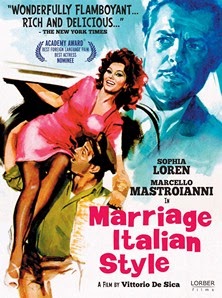
Marriage Italian Style (1964)

I had never seen any of De Sica's later work and with the quintessential pairing of Sophia Loren and Marcello Mastroianni. The character Domenico is easy to dislike from the beginning because he constantly floats in and out of the life of the former prostitute Filumena who is ironically devoted to him.

The film relates the struggles of matrimony and family in Italy as Filumena tries to support her family while struggling with Demenico who is never truly ready to commit to her. In fact he becomes absolute fed up with her after a trick marriage, but that is just the beginning.

I can only imagine what Divorce Italian Style will be like (which also features Mastroianni).

4/5 Stars

Tuesday, February 24, 2015

Yesterday, Today and Tomorrow (1963)

This is the lightest of any De Sica film I had seen up until this point and interestingly enough it was split up into three narratives. The first one follows a woman who continually gets pregnant in order to avoid going to jail, but after seven kids, the toll is too much on her jaded husband. Needless to say there is a happy ending.

The second tale follows a superficial socialite with a Rolls Royce. She ditches her cars as quickly as she ditches her lovers. Although the story does not go very far it is easy to see she is a snob used to getting her own way. Ironically a humble man would in many ways too good for her.

The final vignette follows a friendly prostitute as she befriends a young man destined to join the clergy. However, he becomes smitten and so she must do her best to encourage to continue his calling.

That really is only the basics, but it was certainly enjoyable to see Loren and Mastroianni in three separate roles playing off of each other in different ways. They reflected three very different walks of life and three varying relationships mixing a great deal of humor with a few more somber moments. All in all it was fairly enjoyable.

4/5 Stars

Monday, February 23, 2015

The Young Girls of Rochefort (1967)

If the Umbrellas of Cherbourg is a piercing operatic drama, The Young Girls of Rochefort is pure, unadulterated escapism at its finest. 

Directed by Jacques Demy and starring an ensemble cast including Catherine Deneuve, Francois Doreleac, Gene Kelly, Michel Piccoli, George Chakiris, Grover Paul, and Danielle Darrieux, this is a whimsical French musical that has no equal. 


The film opens with a group of performers coming into the town of Rochefort to get ready for a big outdoor show. They become acquainted with the local hangout that includes a kindly matron and many locals including an idealistic artist and sailor who is searching for his ideal lover. Nearby her two adult twin daughters hold piano and ballet lessons as they two get their little prodigies ready for the big show.  Delphine is fed up with her suitor and desires a new love while Solange on her part hopes to advance her career as a pianist. She goes to the proprietor of a local music store to see if he can introduce her to a prestigious American friend. 

A great deal of dramatic irony sets in and the plot is constantly moved forward through song. Yvonne at the café is still depressed over a split with a lover 10 years prior because he had an unfortunate name. Solange has a chance encounter while stopping to pick up her kid brother Booboo and Delphine becomes curious about an artist who painted a portrait that looks strikingly like her. All of these events reach their apex on the Sunday of the big performance and in need of some performers the Carnies enlist the help of the twins. They are a huge success and things wind down. 


The next morning the performers get ready to leave for Paris and the girls decide to follow suit. However, Solange has another encounter that changes her plans and then Yvonne is reunited with her love. That leaves only Delphine to go with the boys to Paris, but not to worry she would be united with her painter soon enough. 

The light and very French sounding tunes are hard not to like, but that is only the very beginning. Demy pays homage to the Hollywood musicals of old going so far as casting Gene Kelly (Singin' in the Rain) and George Chakiris (West Side Story) in his film. He undoubtedly owes a debts to Vincente Minnelli and Stanley Donen with some striking moments reminiscent of An American in Paris (1951). It makes sense. Demy the pastels and costumes of a Hollywood musical extravaganza while also including dashes of French style. 

Rochefort takes place in a real location but it truly is a fantasy world that the characters inhabit, full of perpetual dancing and dialogue that is delivered through song. The real life sisters do a wonderful job in this film and there is something reassuring seeing Gene Kelly in this film. Rather like an old friend who gives comfort in a whimsical, but altogether new experience. The story arc of dashed, renewed and found love allows Demy to once more explore issues of fate and chance that always seem to enchant him.  His partnership with Michel Legrande is once again bountiful including the endearingly memorable Chanson Des Jumelles. 

There's nothing much else to say except The Young Girls of Rochefort is one of those under appreciated gems that is thoroughly enjoyable and laden with all sorts of fun. It delivers a serving of something that is a familiar flavor while giving it a little extra panache. It's about as playful and fluffy as you can get which in this case is not a bad thing at all. 

4.5/5 Stars

Thursday, February 19, 2015

Jules et Jim (1962)

Directed by Francois Truffaut, this film begins before WWI with two friends, the timid Austrian writer Jules and the more outgoing Frenchman Jim. Both men become enchanted by a statue that a friend had seen and soon Jules meets the free spirited Catherine after being with several women before her. Although he begins a relationship with Catherine, she soon casts her spell on both of them causing them to have a very close relationship. 

Just before the Great War begins Jules and Catherine are married but when the fighting starts the two men are on opposite sides. Fortunately, they both come out of the war and Jim comes to stay with his friends in their mountain home. Now they have a daughter but their marriage is difficult because Catherine has had several affairs. She begins to flirt with Jim and Jules gives his blessing hoping Catherine will still be present in his life. 

Catherine and Jim end up separating however when they struggle to have a child. Later, they reconnect in Paris but Jim resolves to marry another girl much to Catherine’s jealousy. They meet one last time and Catherine goes on a drive with Jim that ends fatally. Jules is left to grieve for his best friend and his true love.

It is interesting how Catherine is really the main character here despite the title suggesting otherwise. Jeanne Moreau does not seem like your typical beauty either and yet Truffaut makes her character truly special. If you want to become acquainted with Truffaut and the style of French New Wave this one of the films you need to go to. The 400 Blows first, Jules and Jim soon after. 

4/5 Stars

Monday, February 16, 2015

The Umbrellas of Cherbourg (1964)

It is hard to remember a time when I was so devastatingly sad due to a film and it does not leave a deep hurt but a far more wistful despondency that is far more real. But that's enough misery for the time being. Directed by Jacques Demy and starring a exquisitely young Catherine Deneuve, this cinematic opera is a moving musical piece that looks to be conventional and turns out to be quite the opposite. 

The story begins in November of 1957 with a young mechanic named Guy (Nino Casteinuovo) who is deeply in love with the beautiful 16 year old Genevieve (Deneuve). Guy cares a great deal for his godmother Elise who has a caregiver to look after her. Genevieve helps out her mother in running a small umbrellas shop in Cherbourg which allows them to scrape by. They must sell some family heirlooms to a kindly jeweler who is smitten with Genevieve. However, Genievieve and Guy have plans of marriage until Guy learns suddenly that he has been drafted for the war in Algieria. They spend their last hours together and she vows to wait for his return. 

In the following months it becomes evident that Genevieve is pregnant, but her mother tells her that Guy has probably forgotten her already. The jeweler, Roland Cassard (Marc Michel), professes his love for Genevieve and agrees to adopt her unborn child. Thus, partially on the urging of her mother Genevieve accepts his proposal and they are soon married leaving Cherbourg for good. 

Finally, Guy returns from the war and things have changed. He now has a limp and is fed up with his old work at the garage. Furthermore, the Umbrellas shop is sold and Geneivieve is wed and gone. Adding insult to injury his godmother soon passes away. With no one else to turn to he looks to the caretaker Madeleine, and he realizes her love for him. They get married and he turns his life around with her help. 

The years pass, and now during Christmas of 1963 a car pulls into Guy’s new gas station. After many years the two former lovers come face to face once mroe. Now they have marriages and children, and their interactions are painfully aloof. They have moved on with their lives and they have moved on from their passionate romance. 


True, their lives have become sensible, but in this opera that Demy has constructed, this conclusion is sad and bittersweet. And yet if this were the only painful moment that would be one thing, but there are so many that touch the heart and move the viewer. When Guy goes off to the army and takes off on the train we can feel the great anguish. More often than not you can read the sadness on the face of these characters which complement the beautiful ballads they utter. In other words it's one thing to recount the plot and quite another to watch the events unfold.

I have to say that I had never seen a film that played out entirely through song and even in the opening sequence Demy consciously melds the diverse forms of film and opera. Umbrellas has the vibrancy and color of movies and takes the dramatic story line and songs of opera to create a unique piece of musical art complete with acts and all. Its colors are bright and vibrant--utterly distinct in their composition. Everything from the bikes to the umbrellas and even back alleyways are beautiful. Although there are many beautiful melodies rather surprisingly there is not one song that stands out (Well, maybe the theme), but instead it plays rather like one continuous song with different sections and overtures that complement but do not overshadow each other.  


Demy's earlier film Lola also gives interesting insight into the character of Roland Cassard who once again becomes acquainted with a mother and her daughter in a shop. This time around he has accomplished his dream of traveling the world as a diamond merchant, however, Lola is still heavy on his heart. Another thing that is remarkable about the film is the weather which in many ways plays as another character. The varying degrees of rain and snow dictate the mood and shift with the changing seasons. There's no doubt that Jacques Demy and his collaborator Michel Legrand created something special here that elevates the musical to a heartfelt tragedy of romance. That's something many men would not be brave enough to do. 

4.5/5 Stars

Saturday, February 14, 2015

Playtime (1967) - Updated

Playtime is a film that really can be broken into a number of set pieces elaborately constructed by director Jacques Tati. The vignettes begin surprisingly enough in an airport terminal and a group of excited Americans are getting ready for a Parisian vacation. Mr. Hulot (Tati hmself) is waiting to have a meeting in a glass office building, however, he soon gets lost in a maze of cubicles, playing cat and mouse with his contact.

 Quite by accident he wanders into an international trade exhibition and the tourists just happen to be there too. While there they are introduced to the latest gizmos, gadgets and inventions to move society forward. They include silently slamming doors and retractable glasses. In typical Tati fashion he gives us a glimpse of the old world from Mon Oncle. All that is left is one meager flower stand and a brief reflection of the Eiffel Tower.

Bumping into an old war buddy, M. Hulot is invited over and thus begins a long sequence in an apartment building. What makes it unusual is that the audience is left out on the street, but we can see multiple interiors through the glass. Thus, the conversation becomes unimportant and the charades inside paired with the street noise is all we notice.

One of the most substantial sequences takes place in a restaurant called the Golden Corkscrew. It is a packed house and the nightclub barely seems prepared for such an evening. Tiles are loose, food runs out, a band member comes late, the chairs leave marks on the backs of patrons and much much more. Hulot stumbles in and comes in contact with several previous acquaintances. He also makes a few new friend including a boisterous American and a friendly female tourist.

After the crazy night, the morning comes and Hulot says goodbye to his new American friend but not before leaving her with a parting gift to remember her memorable time in Paris. It may not be the Paris of old, but it is still a cheery place made by its people who still remain the same even when the times change.

Jacques Tati's Playtime took numerous years to complete and it was the most expensive French production at the time. It makes sense though because it truly is a magnificent piece of cinema. It is full of beautifully choreographed sequences and elaborate sets. Mr. Hulot often finds himself wandering through this labyrinth of modern Parisian humanity. Tati teases us however, filling his world with Hulot doplegangers.

Even when the gangly protagonist is on screen, he often pops off and on for minutes on end. He is no longer the primary focus of the film. Tati also takes great interest in the sterile modern society of glass, steel and technology. The screen is filled with a wide array of individuals, which makes it fascinating to simply people watch. Furthermore, Tati almost refuses to use closeups, thus allowing the camera to capture more.

Playtime is slightly slower to begin with than I remember, but it has wonderful subdued humor paired with social commentary. Tati's film may not have a lot of decipherable dialogue, but there sure is a great deal of noise. His sound effects seem to rival The Three Stooges in comical impact, often filling the void usually devoted to talking. It is moments like these where you see similarities to the old silent comics like Chaplin and Keaton.

Playtime is all about the minutiae and these moments are probably exhibited best at the nightclub. So much happens and much of it goes unnoticed, but oftentimes when you pick up on something the payoff is great, because you slowly begin to notice more and more. Tati does not have to announce it, but he puts it there to be seen. For instance, there is the fish that is never served but constantly being seasoned. Then, the doorman who opens the door without any glass. Finally, there is the waiter who gets all the ripped, torn and otherwise ruined articles of clothing. Together all these moments create some immensely funny sequences.

Another thing about Tati's film. There is really no conflict. He is addressing the changing times, but at its heart Playtime is just that. Light-hearted recreation.

5/5 Stars

Tuesday, February 10, 2015

To Sir, With Love (1967)

Starring Sidney Poitier and set in London, the plot follows a former architect from British Guiana who becomes a teacher at a high school in a tough area. Early on Mark Thackeray faces a rebellious group of teenagers who dislike education and challenge authority whenever possible. He resolves to keep his temper and yet one day their actions are too vulgar for him and he loses it.

After that he develops a new strategy to treat them as adults and he teaches them practical skills they will need in the real world. He changes how they act and takes them on field trips so that even the most combative one Denham is won over. However, after an incident during gym class which he must diffuse, Thackeray loses the respect of much of the class. His mood changes slightly after receiving another job offer.

Later on in the gym class he is supervising he boxes with Denham. In the ensuing moments he wins Denham and then everyone else over once more. With the year finally over, Thackeray is invited to the year end dance where he is given a gift and serenaded with song (To Sir, With Love by Lulu)! Too choked up to speak he retreats to his office. After a chance encounter he resolves to continue teaching and rips up the other offer.

Besides a good theme in "To Sir, With Love," Sidney Potier gives a great performance that makes this film both powerful and touching. If you want a small look into Swinging London this is one to watch. Although I am tempted to find fault in this film I find myself focusing on the positives and I will leave it at that.

4/5 Stars

Monday, February 2, 2015

Lilies in the Field (1963)

Starring Sidney Poitier, the film opens with a black construction worker who has an overheated car in the middle of a desert. He spots at the residence of some European nuns to get water. Homer is intent on making a quick pit stop but the mother superior has other ideas. She sees him as a gift form God so that their Chapel might be built. He reluctantly decides to stick around for a little while to help them out and teach them some English. The stubborn Mother Superior wants everything her way and Homer ends up leaving them. Although he realizes he will not get paid, Homer's ambition to be an architect leads him to eventually start the Chapel for the nuns. He takes on a part time job and starts the undertaking while the nuns request materials. Soon the locals want to help but Homer is adamant that he do everything. Eventually they do join in and more materials come. Progress picks up and Homer becomes the foreman. The building is finally put up and yet the proud Mother will not thank Homer. That night she is finally tricked into thanking him and Homer leads them in a spiritual one last time before driving off into the night. This film is a battle of sorts between two strong-willed people. In the end it brings a great deal of good.

4/5 Stars

Saturday, January 17, 2015

Support Your Local Sheriff (1969)

Funeral sequences are a mainstay of the western genre because they give us a chance to peer inside of characters and examine the time and place that is the west. It can be tough, hard and most certainly brutal. Support Your Local Sheriff is a barrel full of fun because it takes many of these set pieces and subverts them for the sake of humor.

It opens with one of these typical solemn wakes for a man that no one seems to know or care much about. All too soon everyone is distracted by a speck of gold and mayhem commences. It sets the tone for the entire film and the people we will soon become acquainted with. All the action is wonderfully exaggerated by a frantic harmonica laden score with jaw harp to boot. It's twangy madness that works to a tee. But enough of that.

The mining town of Calendar is a wild, untamed place built for the sold purpose of mining. The rough and tumble Danby Family seem to have a monopoly on the gold trade controlling the only road out of the town. It's a big mess.

That's the climate that Jason McCullogh walks into (James Garner) on his way to Australia. After seeing Joe Danby (Bruce Dern) kill a man he decides to sign on as the town's sheriff. Town "mayor" Olly Perkins and his entourage are surprised that any person would want to take the job, but after seeing Jason's marksmanship they giddily agree. Quickly he astutely breaks up mud fights, puts Danby in jail and finds himself a deputy in Jake (Jack Elam).

Most of the rest of the film follows Pa Danby (Walter Brennan) and his two nitwit sons as they try and get their equally dumb baby brother out of prison. It's followed by a long line of hired gunman who all fail out knocking the sheriff off.  Jason also has encounters with Perkins' often ditsy daughter Prudy (Joan Hackett). It would be wrong to say that Prudy is the only whimsy one because it feels like everyone in town has a screw loose, from the hero to the villains.

That's what makes Support Your Local Sheriff so appealing. James Garner is as charming a wise cracker as ever, but on a whole this film is full of comedic misunderstandings, caterwauling and stupidity with an ignoramus around every corner. There's a jail without bars, villains who are wimps, a girl who hides in a tree and lights herself on fire, even a protagonist who seems bent on heading off to the real frontier in Australia. What?


Thus, this rewriting of your typical western trope of a man taming the west works out quite well and in many ways feels like a precursor to Blazing Saddles. It was a lot of fun to have two personal favorites in James Garner (The Rockford Files) and Harry Morgan (MASH) in a film together. Joan Hackett was a lot of fun too. I really want to see more with her (ie. Will Penny, The Last Sheila).

3.5/5 Stars
Related Posts Plugin for WordPress, Blogger...