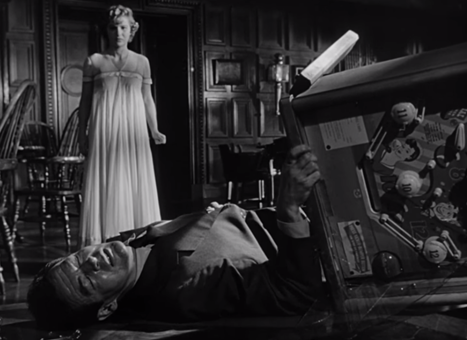
The Big Heat is not a Noir where the darkness comes from the shadowy visuals, but from within its characters themselves. In fact, some of these individuals are so subtle in their corruption that it easily gets overshadowed. Homicide cop Dave Bannion is ironically the straight-arrow trying to do what is right and he becomes the most vengeful character in Fritz Lang's film. It's a subversion of the typical noir arc, because his greatest help ultimately comes from the former femme fatale. That's not how it's supposed to happen, but then again a lot of things happen a little differently in The Big Heat.
The film opens and within a second a man has shot himself and left a confession his desk. The cues tell us that he's a cop and he's just committed suicide. His wife comes down stairs strangely composed and shuffles through the pages he has written. She goes to the phone, not to call the police, but she talks to a third party. We quickly forget what's she's done, but the fact is Mrs. Duncan represents the corruption that reigns supreme in this film. She's used a juicy piece of blackmail to receive large payoffs from someone and she's not the only sellout.
Bannion (Glen Ford) is a cop by day and a family man at night with a loving wife and a beautiful little girl. By convention he is supposed to be the moral compass of this film -- the emblem of good versus evil. He takes on the straightforward case of officer Duncan's death, but it gets convoluted when a B girl named Lucy Chapman calls him up to say she knew the deceased and he would never kill himself. Initially Bannion, like us originally, takes little heed of this girl because she is hardly as respectable as Mrs. Duncan or so society says.
He gets pressure from his superior Wilks to lay off, but Bannion is discontent with lose ends especially when he receives news that the Chapman girl has been brutally murdered. This can't all be all coincidence and he begins sniffing out the truth like a bloodhound. Bannion leads us into the home of this empire of crime literally. He confronts local businessman/crime boss Mike Laganna, who he accuses of involvement in the corruption. Things are beginning to heat up and they begin to infiltrate the sanctity of his home life. The dark recesses of the noir world can never be subdued and Bannion dives deeper into the labyrinth that is created by his own obsessive vendetta. He has no tolerance for his colleagues who don't take a stand in favor of a pension. He can't stand tight-lipped locals who give him no help and most of all he hates Laganna's guts.
At the local shady nightclub The Retreat Bannion has his first run-in with the hired thug Vince Stone (Lee Marvin). Afterwards Vince's girl Debby is genuinely impressed by Bannion's methods, but he will not give her the time of day. He expects her to be the same superficially ditsy dame that we have all seen before. Hardly a femme fatale, but still there is the potential to be deadly. The one character who seems to conform to the stereotype is Stone, and yet he is even more brutal than most burning girls with cigarette butts and splashing scalding coffee on Debby's face.
Bannion gets to one of the other hired guns Larry and both Stone and Laganna decide that something must be done to stop Bannion in his tracks. The obvious target is his little girl, but this time the family life prevails over the noir world. His family and colleagues rally around him and yet Bannion is not done with his obsession.
In fact, it is Debby who actually finishes off Bannion's work by paying a visit to Mrs. Chapman and then too Vince to pay her respects. Bannion arrives soon after to reprimand Vince, but Debby has already done the dirty work. The nightmare is over and everything that is good and right comes to the forefront. Debby proves her allegiance, the criminals are put away and Bannion gets a new position with homicide. But underlying this seemingly happy ending is still a sense of tension. The film ends as Bannion heads out on a new homicide case with the cycle continuing and it seems like he will never be free of it. The world will continue ripping away the ones he loves before he is left with only his personal vengeance to drive his future. Bannion very easily could cross the line between righteousness and corruption. He already almost strangled two characters and was not opposed to slugging it out with others. It's only a matter of time before he totally blows his cool and collected cover. It's a dark assumption, but then again that is a lot of what film-noir is. Fritz Lang seems to get this and that's what makes his characters here so powerful, because he knows that the root of all evil can be in everyone.
4.5/5 Stars
Preserving a love of artistic, historically significant and entertaining movies.
Showing posts with label Film Noir. Show all posts
Wednesday, July 15, 2015
The Big Heat (1953) - Updated
Labels:
1950s
,
Film Noir
,
Fritz Lang
,
Glen Ford
,
Lee Marvin
,
Long Review
Monday, July 13, 2015
Gun Crazy (1950) - Updated
Bart has an intense obsession for guns. It's what his life
revolves around. It's the only thing he wants to do as a boy and the only
things he seems to think about. It becomes a problem when he breaks a store
window, but during the following hearing his sister and friends vouch for his
character. He would never take a him life or kill. That's not in his nature.
No matter, it is decided Bart should be
sent off to a special preparatory school and he only returns years later as a
grown man recently off a stint in the army. He's back in his home town
not quite sure what his future plans will be, but his buddies are glad to see
him. They shoot some, drink a few beers and decide to take a jaunt to the
carnival for a night of fun.
Their Bart meets the girls of his dreams.
There's a quality to John Dall that makes Bart into a pure victim of a
character. He's quickly infatuated with the gun slinging and sensuous Peggy,
who seems to share his one love. A goofy smile is plastered on his face as he
faces off against her in an act of skill. He makes her uneasy and ultimately
beats her.
He gets a job with the carnival and spends
as much time as he can with her when he's not shooting guns. They are fed up
with their boss and leave the migrant life behind. Marriage is on their radar
and they live it up with the money they have. But Peggy wants more and she
wants to keep living the high life.
She wants to rob a gas station. It's one
little idea that soon blows way out of proportion. They are holding up banks,
gas stations and any place with money that they can lay their hands on. The
pair are fugitives with exploits plastered all over the front pages and
roadblocks waiting to stop them up. All the while Bart makes Peggy promise not
to shoot anything, because he still is totally opposed to killing people.
It seems like things might end peaceably,
except once again the gun-toting lovers are nearly flat broke so Peggy coaxes
Bart into one last job to end all jobs. For the first time, despite their
planning, just enough goes wrong to nearly botch their mission. Bart drives off
and Peggy shoots a guard. He's not the only one.
When Bart finds out after the fact he
realizes they have just stepped up a level with murder stuck on them. The game
is winding down and the only place Bart can turn is his home town where his
sister is. For good reason she cannot stand Bart or Peggy who she sees as
poisoning her brother. And it's true Bart seems different now, so paralyzed by
fear that he even pulls a gun on his old friends.
The last ditch effort of Bart and Peggy is
to literally head for the hills. The dragnet is sent out and the hounds are let
loose. They hardly have a chance before dropping from exhaustion in a swamp.
They're trapped and a crazed Peggy looks to shoot it out to the death. But for
once Bart breaks with her remembering his friends. It doesn't help him much.
Gun Crazy is a B-film and yet it is easy
to forget or at least the way Joseph Lewis constructed this film is impressive
in its economy. One scene that reflects this so beautifully is the long take
from the back of the car. The camera does not change positioning and so we see
a bank job from the outside and it only helps to build up greater tension.
We also have enough time to care
about certain characters. We have enough time to see Peggy is really no good.
Yet with her keen marksmanship she is a different shade of femme-fatale who is
still as deadly as any of her contemporaries. Along with They Live by Night
(1948), this is one of the archetypal Bonnie and Clyde-esque films. Thank
goodness this film's title was changed from Deadly is the Female to the more
apt Gun Crazy. That it is.
4/5 Stars
Labels:
1950s
,
Film Noir
,
Long Review
Friday, July 10, 2015
While the City Sleeps (1956)
While the City Sleeps has a brilliant cold open followed by a pounding title sequence courtesy of Fritz Lang that brings to mind a bit of Diabolique and Psycho. The rest of the film turns into a case to find the wanted lipstick murderer (based on a real killer), but that only holds part of our attention.
When newspaper magnate Mr. Kyne dies suddenly his begrudging son Walter (Vincent Price) takes over intent on shaking up the status quo and putting his mark on the company. He soon turns three men against each other as they desperately fight for the new position of executive director. The first is veteran newspaper editor John Day Griffith (played by the always memorable character actor Thomas Mitchell). The second candidate is chief of the wire service Mark Loving (George Sanders) who is Griffith's main competitor. Finally, in the third spot is Harry Kritzer who happens to have a secret ace in the hole. Each of them is tasked with finding out the real scoop about the serial killer and it turns into a real tooth and claw ordeal. Within the glass cubicles everything can be scene, but not everything is heard and that's where the secrets get disclosed.
On the outside looking in so to speak is star TV reporter Edward Mobley, who agrees to help his friend Griffith by doing a little digging around about the murderer. He gets some tips from a cop friend Lt. Kaufmann (Howard Duff) and Mobley tries to spoke the killer out on air. However, it leads to the potential endangerment of his fiancee Nancy, who also happens to be Loving's secretary. Loving has his love directed towards a female reporter named Midred Donner (Ida Lupino), who attempts to needle Mobley for info. At the same time the killer is on the move once more, with Nancy being an obvious target. Mr. Kritzer's own romantic entanglements get him in trouble because he is seeing Kyne's beatiful but detached wife Dorothy (Rhonda Fleming). Mildred finds out about them and they have some talking to do. Mobley also has some making up to do with Nancy after she finds out Mildred came to see him.
Mobley juggles everything from his love life to the big scoop and they apprehend the killer, but things at Kyne's don't wind up exactly the way they expected. Mobley looks to move on from the paper with Nancy, but even he cannot get away that easily.
While the City Sleeps is an underrated tale from Lang that is positively stacked with big names. It's pacing can be deliberate at times, but it is just as much a indictment of journalism as it is a thriller. The office is a web of deception with so many interconnections between these work factions. Those you would normally expect to be scrupulous seem to give up their honor in the face of this new promotion. In a sense Mobley seems to be outside of this fray and yet he cannot help, but get involved in it. It doesn't help that nothing turns out the way it's supposed to. Everybody seems to gain something, but nobody really wins the game.
I must say it was great to see Dana Andrews in one of these leading roles again and although their roles were smaller Ida Lupino and George Sanders still had a deliciously stuffy and corrupt pair. I was never a fan of Vincent Price due to the roles he normally plays, but I was inclined to like Howard Duff (Lupino's real-life husband) in his turn as the policemen. It goes without saying that Rhonda Fleming is positively beautiful, but she also cannot be trusted. I guess that applies to about every character in this film. It's certainly a cynical world out there that Lang paints, where the killer might be caught, but corruption is never fully quelled.
4/5 Stars
When newspaper magnate Mr. Kyne dies suddenly his begrudging son Walter (Vincent Price) takes over intent on shaking up the status quo and putting his mark on the company. He soon turns three men against each other as they desperately fight for the new position of executive director. The first is veteran newspaper editor John Day Griffith (played by the always memorable character actor Thomas Mitchell). The second candidate is chief of the wire service Mark Loving (George Sanders) who is Griffith's main competitor. Finally, in the third spot is Harry Kritzer who happens to have a secret ace in the hole. Each of them is tasked with finding out the real scoop about the serial killer and it turns into a real tooth and claw ordeal. Within the glass cubicles everything can be scene, but not everything is heard and that's where the secrets get disclosed.
On the outside looking in so to speak is star TV reporter Edward Mobley, who agrees to help his friend Griffith by doing a little digging around about the murderer. He gets some tips from a cop friend Lt. Kaufmann (Howard Duff) and Mobley tries to spoke the killer out on air. However, it leads to the potential endangerment of his fiancee Nancy, who also happens to be Loving's secretary. Loving has his love directed towards a female reporter named Midred Donner (Ida Lupino), who attempts to needle Mobley for info. At the same time the killer is on the move once more, with Nancy being an obvious target. Mr. Kritzer's own romantic entanglements get him in trouble because he is seeing Kyne's beatiful but detached wife Dorothy (Rhonda Fleming). Mildred finds out about them and they have some talking to do. Mobley also has some making up to do with Nancy after she finds out Mildred came to see him.
Mobley juggles everything from his love life to the big scoop and they apprehend the killer, but things at Kyne's don't wind up exactly the way they expected. Mobley looks to move on from the paper with Nancy, but even he cannot get away that easily.
While the City Sleeps is an underrated tale from Lang that is positively stacked with big names. It's pacing can be deliberate at times, but it is just as much a indictment of journalism as it is a thriller. The office is a web of deception with so many interconnections between these work factions. Those you would normally expect to be scrupulous seem to give up their honor in the face of this new promotion. In a sense Mobley seems to be outside of this fray and yet he cannot help, but get involved in it. It doesn't help that nothing turns out the way it's supposed to. Everybody seems to gain something, but nobody really wins the game.
I must say it was great to see Dana Andrews in one of these leading roles again and although their roles were smaller Ida Lupino and George Sanders still had a deliciously stuffy and corrupt pair. I was never a fan of Vincent Price due to the roles he normally plays, but I was inclined to like Howard Duff (Lupino's real-life husband) in his turn as the policemen. It goes without saying that Rhonda Fleming is positively beautiful, but she also cannot be trusted. I guess that applies to about every character in this film. It's certainly a cynical world out there that Lang paints, where the killer might be caught, but corruption is never fully quelled.
4/5 Stars
Labels:
1950s
,
Dana Andrews
,
Film Noir
,
Fritz Lang
,
Long Review
Wednesday, July 8, 2015
The Spiral Staircase (1945)
The Spiral Staircase plays out like a Agatha Christie murder mystery with a moody, old mansion acting as the backdrop and numerous individuals filling out the cast. It seems to be some type of Gothic Noir hybrid, with its ghostly interiors, torrential thunderstorms and creaky shutters. However, with director Robert Siodmak at the helm, I am inclined to call it Noir, not just because of his pedigree, but it certainly has the atmosphere and dim interiors that are expected of the genre.
The action opens at a movie hall after a woman is murdered by an unseen killer, but most of the actual drama takes place in the before mentioned mansion of the sickly Mrs. Warren (Ethel Barrymore). She resides with her son Steven and step-son Professor Albert Warren (George Brent) who never see eye to eye. Nearly on her death bed Mrs. Warren distrusts her nurse and only allows the mute girl Helen (Dorothy McGuire) to even help her. The rest of the cast is rounded out by servants, a secretary named Blanche (Rhonda Fleming) who Steven loves, and the constable and a young doctor who cares about Helen. It's a wide array of figures and we quickly begin to analyze them for any hint of killer tendencies.
In fact, Helen is our main character and we experience much of the film from here perspective. The truth of the matter is that all the girls who were killed had some sort of defect, so the line of reasoning is that Helen might be next in line. It seems all too possible with a pair of mysterious eyes constantly watching from the shadows, but Helen does not heed Mrs. Warren's advice to flee.
The film ultimately spirals into darkness as the killer takes one victim and looks for another. Helen must protect herself while also confronting her past where the source of her muteness lies. Although simple in conception, The Spiral Staircase is no less an engaging mystery. It is not the best from Siodmak either, but Dorothy McGuire gives an expressive performance that deliverers so much heart and feeling without the use of words. However, the film does ultimately allow her to find her inner voice in the midst of all the silence. She finally conquers the fear in the time when it is most harrowing. Although her role is rather minor Rhonda Fleming is as strikingly beautiful as ever. It's a rather expected resolution, but there are enough quirks and twists to makes things enjoyable to the end. It goes without saying that Gothic Noir most definitely should be a thing if it isn't already.
4/5 Stars
The action opens at a movie hall after a woman is murdered by an unseen killer, but most of the actual drama takes place in the before mentioned mansion of the sickly Mrs. Warren (Ethel Barrymore). She resides with her son Steven and step-son Professor Albert Warren (George Brent) who never see eye to eye. Nearly on her death bed Mrs. Warren distrusts her nurse and only allows the mute girl Helen (Dorothy McGuire) to even help her. The rest of the cast is rounded out by servants, a secretary named Blanche (Rhonda Fleming) who Steven loves, and the constable and a young doctor who cares about Helen. It's a wide array of figures and we quickly begin to analyze them for any hint of killer tendencies.
In fact, Helen is our main character and we experience much of the film from here perspective. The truth of the matter is that all the girls who were killed had some sort of defect, so the line of reasoning is that Helen might be next in line. It seems all too possible with a pair of mysterious eyes constantly watching from the shadows, but Helen does not heed Mrs. Warren's advice to flee.
The film ultimately spirals into darkness as the killer takes one victim and looks for another. Helen must protect herself while also confronting her past where the source of her muteness lies. Although simple in conception, The Spiral Staircase is no less an engaging mystery. It is not the best from Siodmak either, but Dorothy McGuire gives an expressive performance that deliverers so much heart and feeling without the use of words. However, the film does ultimately allow her to find her inner voice in the midst of all the silence. She finally conquers the fear in the time when it is most harrowing. Although her role is rather minor Rhonda Fleming is as strikingly beautiful as ever. It's a rather expected resolution, but there are enough quirks and twists to makes things enjoyable to the end. It goes without saying that Gothic Noir most definitely should be a thing if it isn't already.
4/5 Stars
Labels:
1940s
,
Film Noir
,
Long Review
,
Robert Siodmak
Saturday, June 27, 2015
Brute Force (1947)
The story follows the inmates as make due with prison life and bide their time waiting for parole. However, Joe Collins who is fresh off a spell of solitary confinement seems bent on escape. The prison warden is an older fellow struggling to keep tempers boiling over. The likable but often inebriated doctor (Art Smith) can see the writing on the wall. Things are reaching the end of the line if Munsey continues to hike up his tactics that make the men resent him more each and every day.
The entirety of the film takes place within the confines of the prison except for a couple flashbacks as four men recall the women they left outside in the real world. They are played by Anita Colby, Ella Raines, Yvonne De Carlo and Ann Blyth respectively, reflecting the hope, memories and loved ones who are pulling at these men and ultimately led them to get into trouble.
One man hangs himself after words from Munsey and another gets it for causing problems for Joe. Neither of these men is looking to stand down anytime soon as Joe cautiously begins enacting plans of escape with another prisoner named Gallagher (Charles Bickford). Munsey continues to hound prisoners for information while halting all privileges.
Ultimately, the finale turns out to be the most electrifying moments of the film while simultaneously Munsey is made the new warden and Collins puts his plan in action. Guards are waiting for him and his crew, but Gallagher has plans of his own in the compound. It leads to a handful of explosions, endless mayhem and more than a few deaths. This is what happens when you use brute force and it's far from a pretty sight.
4/5 Stars
Labels:
1940s
,
Burt Lancaster
,
Film Noir
,
Jules Dassin
,
Long Review
Thursday, June 25, 2015
The Killers (1946) - Updated
It's been said that Robert Siodmak's The Killers was Ernest Hemingway's favorite adaption of one of his works which was in this case a short story. As a film-noir it works on numerous levels from the cinematography, to the score, to the young stars, to the ingenious narrative. Some credit of course can go to Hemingway for the concept, but a lot of the creative success must be given to the likes of Siodmak, John Huston and a host of others.
The film opens in an instant with two lurking gunmen entering a diner in a small New Jersey town called Brentwood. Their target is washed up boxer called "The Swede" and we do not know why, but after terrorizing a few locals they riddle him with bullet holes and that's the end of it. It's an intense sequence because the thugs (William Conrad and Charles McGraw) are antagonistic and Miklos Rozsa's score is nearly relentlessness.
The story could have ended there if it wasn't for an insurance investigator named Reardon (Edmond O'Brien), who takes an interest in the dead man so he can find his beneficiary. In the present he begins to piece together little fragments of the boxer's past slowly but sure.
It starts out with Nick Adams who witnessed the thugs and worked with The Swede when a mysterious man came by the filing station. Soon after Ole Andreson stopped coming in to work and a while later he was dead. That's all Nick knows and it does not give Reardon much to go on.
Next he tracks down The Swede's beneficiary who turns out to be a kindly hotel maid. The connection seems slim but it turns out that she kept him from committing suicide after a tough evening where he tore his flat apart. It's not much to go on but Reardon thanks her and moves on with his investigation still intrigued.
Then he goes to Philadelphia and gets his biggest puzzle piece from a policeman named Lubinsky, who used to run with the Swede as kids and probably knew him the best of anyone. He and his wife explain to Reardon how Pete Llund as he was known lost his final bout and was forced to move on wit his life. About that time he met Kitty Collins for the first time and was infatuated for life.
Charleston is next, the old stooge who spent a good many years locked up in a cell with the Swede. Reardon comes upon him at the funeral and from the old convict he learns about a bank job that the washed up boxer got involved in. The other partners were Blinky, Dum Dum and Big Jim. They are Reardon's next points of interest.
Blinky is near death and recounts the robbery. Dum Dum crosses path with Reardon and shares about the aftermath of the job which went sour. Next comes Big Jim whose tight-lipped about the past. Last but not least is Kitty, who is fearful that Reardon knows something and can actually blackmail him. It's when everything begins to lineup and heat up. After being absent for so long the Killers are back in the picture and Rozsa's score picks up again threatening the status quo of the film. They put us on edge again and for good reason. But the real focal point of the ending is Kitty.
Obviously Citizen Kane has so many layers of interest, but it shares a similar narrative arc to the Killers where a main character is killed and his story gets pieced together thanks to flashbacks that are furnished from the present. Except in many ways the story of The Swede intrigues me more as a character. Charles Foster Kane is a magnate with an impressive if not tragic life.
Swede's life is probably just as tragic except it was more humble and full of more crime. He was small time and he even failed in love when his friend Lubinsky got the girl of his dreams. It's an interesting life too that ended unnaturally with gunshots rather than Kane who died as an old man. The Swede was cut short in a tragic sort of way and I think that's part of what intrigues Reardon. It's more than a job, but a mysterious story of a man's life that the audience also gets taken along for. As far as storytelling goes its great and it really works to flesh out these characters.
Ultimately, Reardon feels like the main character of sorts, but such an aura is built around The Swede and Kitty that it is understandable that this film made stars out of Lancaster and Gardner. They are certainly memorable partially because we hardly ever seen them in the present (except for Kitty at the end). Their whole persona is built off of what others say and there's something interesting about that. There's the fatalistic and sullen Swede which turned out be be a perfect debut for Burt Lancaster. Ava Gardner has the soft seductive whisper of lethal poison all wrapped up in a beautiful body and it leaves a major impression.
Above else The Killers is a prime example of film noir blending German Expressionism from Siodmak's native Germany with more documentary style sequences that take inspiration from post-war neo-realism. The opening sequence especially drips with noir sensibilities that at its most dramatic looms with shadows from the exterior of the diner to the low key lighting of the Swede's bedroom. For a while it's even difficult to know that's Burt Lancaster reclined on the bed because his whole body is fully encased as he speaks. It's only when he gets up into the light that we finally are introduced before he gets gunned down a few minutes later. It's great staging and the atmosphere remains for a great deal of the film from the prison cell to Big Jim's mansion. Each place is contrasted with the present or other locales like Reardon's office which are more natural. It doesn't get much better than that.
4.5/5 Stars
The film opens in an instant with two lurking gunmen entering a diner in a small New Jersey town called Brentwood. Their target is washed up boxer called "The Swede" and we do not know why, but after terrorizing a few locals they riddle him with bullet holes and that's the end of it. It's an intense sequence because the thugs (William Conrad and Charles McGraw) are antagonistic and Miklos Rozsa's score is nearly relentlessness.
The story could have ended there if it wasn't for an insurance investigator named Reardon (Edmond O'Brien), who takes an interest in the dead man so he can find his beneficiary. In the present he begins to piece together little fragments of the boxer's past slowly but sure.
It starts out with Nick Adams who witnessed the thugs and worked with The Swede when a mysterious man came by the filing station. Soon after Ole Andreson stopped coming in to work and a while later he was dead. That's all Nick knows and it does not give Reardon much to go on.
Next he tracks down The Swede's beneficiary who turns out to be a kindly hotel maid. The connection seems slim but it turns out that she kept him from committing suicide after a tough evening where he tore his flat apart. It's not much to go on but Reardon thanks her and moves on with his investigation still intrigued.
Then he goes to Philadelphia and gets his biggest puzzle piece from a policeman named Lubinsky, who used to run with the Swede as kids and probably knew him the best of anyone. He and his wife explain to Reardon how Pete Llund as he was known lost his final bout and was forced to move on wit his life. About that time he met Kitty Collins for the first time and was infatuated for life.
Charleston is next, the old stooge who spent a good many years locked up in a cell with the Swede. Reardon comes upon him at the funeral and from the old convict he learns about a bank job that the washed up boxer got involved in. The other partners were Blinky, Dum Dum and Big Jim. They are Reardon's next points of interest.
Blinky is near death and recounts the robbery. Dum Dum crosses path with Reardon and shares about the aftermath of the job which went sour. Next comes Big Jim whose tight-lipped about the past. Last but not least is Kitty, who is fearful that Reardon knows something and can actually blackmail him. It's when everything begins to lineup and heat up. After being absent for so long the Killers are back in the picture and Rozsa's score picks up again threatening the status quo of the film. They put us on edge again and for good reason. But the real focal point of the ending is Kitty.
Obviously Citizen Kane has so many layers of interest, but it shares a similar narrative arc to the Killers where a main character is killed and his story gets pieced together thanks to flashbacks that are furnished from the present. Except in many ways the story of The Swede intrigues me more as a character. Charles Foster Kane is a magnate with an impressive if not tragic life.
Swede's life is probably just as tragic except it was more humble and full of more crime. He was small time and he even failed in love when his friend Lubinsky got the girl of his dreams. It's an interesting life too that ended unnaturally with gunshots rather than Kane who died as an old man. The Swede was cut short in a tragic sort of way and I think that's part of what intrigues Reardon. It's more than a job, but a mysterious story of a man's life that the audience also gets taken along for. As far as storytelling goes its great and it really works to flesh out these characters.
Ultimately, Reardon feels like the main character of sorts, but such an aura is built around The Swede and Kitty that it is understandable that this film made stars out of Lancaster and Gardner. They are certainly memorable partially because we hardly ever seen them in the present (except for Kitty at the end). Their whole persona is built off of what others say and there's something interesting about that. There's the fatalistic and sullen Swede which turned out be be a perfect debut for Burt Lancaster. Ava Gardner has the soft seductive whisper of lethal poison all wrapped up in a beautiful body and it leaves a major impression.
Above else The Killers is a prime example of film noir blending German Expressionism from Siodmak's native Germany with more documentary style sequences that take inspiration from post-war neo-realism. The opening sequence especially drips with noir sensibilities that at its most dramatic looms with shadows from the exterior of the diner to the low key lighting of the Swede's bedroom. For a while it's even difficult to know that's Burt Lancaster reclined on the bed because his whole body is fully encased as he speaks. It's only when he gets up into the light that we finally are introduced before he gets gunned down a few minutes later. It's great staging and the atmosphere remains for a great deal of the film from the prison cell to Big Jim's mansion. Each place is contrasted with the present or other locales like Reardon's office which are more natural. It doesn't get much better than that.
4.5/5 Stars
Labels:
1940s
,
Ava Gardner
,
Burt Lancaster
,
Film Noir
,
Long Review
,
Robert Siodmak
Wednesday, June 24, 2015
Caught (1949)
She's a little bit different than the others but they have slowly made her buy in to the whole system. Then one night she gets what all these gold digging girls could only dream of, she meets the filthy rich and oddly-named Smith Ohlrig (Robert Ryan) and it's all quite by accident.
Soon more to prove a point than for love, Smith marries Leonora and she tries her best to love him like a good wife. But he's too busy and too difficult to get close to. She spends all her days stuck at home and unhappy with Smith's hired aide Franzi Kartos (Curt Bois). Leonora realizes she needs something else and heads out to get a job away from Smith and his money.
The first opportunity she gets is at a receptionist for a doctor's office of a kindly young pediatrician and his older colleague across the hall (Frank Ferguson). She pegs her as an odd applicant from the beginning, but allows her to come on and work. Once she commits, Leonora proves to be a hard worker and she and Dr. Quinada (James Mason) hit it off, though he still finds her peculiar.
Once more Leonora tries to patch things up with Ohlrig who begs her to come back home, which she does. Because she wants their marriage to still work out. However, Leonora also gets some big news from a doctor that complicates the situation. She truly is caught. She cannot leave Smith due to their marriage and other difficulties while her affections truly lie with kindly Dr. Quinada who feels the same.
Ultimately, there has to be a showdown and so there is. Leonora has to make her decision. Then Smith has one of his angina attacks and she doesn't want to help him. It causes her increased guilt and ensuing complications. But Ohlrig doesn't die and Leonora finally has the future she wants with Quinada.
Max Ophul's was always a master with these types of melodramas and his trademark dolly shots are as prevalent as ever developing some of the scenes wonderfully. It becomes more than a plot but a visual presentation too and the shots often are augmented by how he moves in and about a room. Robert Ryan steps into the villainous role easily and James Mason is a surprisingly amiable good guy. Also, though his role is small, Frank Ferguson is nonetheless pivotal and thoroughly enjoyable as a fatherly figure. Of course Barbara Bel Geddes is a worthy protagonist, because she is ultimately the one trapped between her two male counterparts and she is the one who goes through the most mental torment with Ohlrig potentially being close behind. Above all Caught is a timeless indictment not simply of corrupt capitalism but a general philosophy that money is everything. Quinada has the best approach, realizing that money is necessary, but it can never buy you happiness or remedy your relationships. Smith will never figure that out and it is difficult for Leonora to leave that worldview completely behind; as it is for many of us.
4/5 Stars
Labels:
1940s
,
Film Noir
,
James Mason
,
Long Review
,
Max Ophuls
,
Robert Ryan
Monday, June 22, 2015
They Live by Night (1948)
Regrettably I have seen very little of Nicholas Ray, however from his debut in They Live by Night I saw the same care spent on his youthful characters, which is also noticeable in Rebel Without a Cause. He does not treat "Keechie" and "Bowie" as cardboard cutouts or kids who are dumb and in love. They have value and feelings that are worth examining more closely.
The film opens with three thugs breaking out of the local prison. Two of the men Chicamaw (Howard Da Silva) and T-Dub (Jay C. Flippen) are weathered criminals. The third, Bowie is a baby-faced kid looking hardly a day over 20, but he went into the clink for a reason.
They find shelter at a nearby filing station where Chicamaw's mangy older brother (Wil Wright) makes a living with his timid, no nonsense daughter Katherine.They get a car and have enough money to get their feet off the ground before a big bank job in Kelton.
It goes off without a major hitch but soon after Bowie gets in a car accident and Chicamaw takes him back to his brother's to be cared for. Katharine is there and the two of them find companionship in each other because neither one has anyone else to turn to. They are young, naive and in love. They've never had these types of feelings before.
Since Bowie needs to lay low, he takes "Keechie" with him and they make an adventure out of it. Ultimately, it results in a cheap $20 marriage and a lot of nice intimate nights spent together driving and cuddling. They're living the lives of carefree newlyweds who need no one but each other. They find a simple cottage out in the back country owned by a homely proprietor (Byron Foulger) and it acts as a new home. A perfect oasis from the newspapers, the cops and Bowie's accomplices.
However, they do catch up with him eventually and he and Katherine split fast after a tiff. They want a normal life, but Chicamaw and T-Dub won't allow it because they need more money. He won't and in the subsequent attempt his former partners eat it. The lookout is still hot for the boy as well.
He seems so undeserving of hard justice, but it is bound to come after him anyways. For such relative newcomers Farley Granger and Kathy O'Donnell (The Best Years of Our Lives) have such genuine chemistry opposite each other. Granger is more often than not gentle and kind. O'Donnell is pretty in a simple, unadorned type of way. They elicit so much more sympathy than Bonnie and Clyde or even the fugitives in Gun Crazy. Perhaps because they aren't even outlaws, only young kids who are victims of their circumstances.
4/5 Stars
The film opens with three thugs breaking out of the local prison. Two of the men Chicamaw (Howard Da Silva) and T-Dub (Jay C. Flippen) are weathered criminals. The third, Bowie is a baby-faced kid looking hardly a day over 20, but he went into the clink for a reason.
They find shelter at a nearby filing station where Chicamaw's mangy older brother (Wil Wright) makes a living with his timid, no nonsense daughter Katherine.They get a car and have enough money to get their feet off the ground before a big bank job in Kelton.
It goes off without a major hitch but soon after Bowie gets in a car accident and Chicamaw takes him back to his brother's to be cared for. Katharine is there and the two of them find companionship in each other because neither one has anyone else to turn to. They are young, naive and in love. They've never had these types of feelings before.Since Bowie needs to lay low, he takes "Keechie" with him and they make an adventure out of it. Ultimately, it results in a cheap $20 marriage and a lot of nice intimate nights spent together driving and cuddling. They're living the lives of carefree newlyweds who need no one but each other. They find a simple cottage out in the back country owned by a homely proprietor (Byron Foulger) and it acts as a new home. A perfect oasis from the newspapers, the cops and Bowie's accomplices.
However, they do catch up with him eventually and he and Katherine split fast after a tiff. They want a normal life, but Chicamaw and T-Dub won't allow it because they need more money. He won't and in the subsequent attempt his former partners eat it. The lookout is still hot for the boy as well.
He seems so undeserving of hard justice, but it is bound to come after him anyways. For such relative newcomers Farley Granger and Kathy O'Donnell (The Best Years of Our Lives) have such genuine chemistry opposite each other. Granger is more often than not gentle and kind. O'Donnell is pretty in a simple, unadorned type of way. They elicit so much more sympathy than Bonnie and Clyde or even the fugitives in Gun Crazy. Perhaps because they aren't even outlaws, only young kids who are victims of their circumstances.
4/5 Stars
Labels:
1940s
,
Film Noir
,
Long Review
,
Nicholas Ray
Friday, June 19, 2015
Force of Evil (1948)
"This is Wall Street... and today was important because tomorrow - July Fourth - I intended to make my first million dollars. An exciting day in any man's life. Temporarily, the enterprise was slightly illegal. You see I was the lawyer for the numbers racket" ~ Joe Morse
Not in recent memory has a film left such a different taste in my mouth. Force of Evil has all the trappings of a thoroughly engrossing noir crime film. There's the crooked lawyer Joe Morse (John Garfield) looking to get ahead by helping a top level gangster named Tucker take over the numbers racket in New York. There's his estranged older brother Leo (Thomas Gomez) wanting nothing to do with his brother's dirty money. It's a classic Cain and Able type conflict. Add realistic location shooting inter-cut with voice-over, and a David Raksin score to make a real winner.
Yet Force of Evil is a dangerous film to take at face value because on that level alone it is highly entertaining. However, director and screenwriter Abraham Polonsky created something special here at only 78 minutes in length. His film has a certain rhythm that is hard to pinpoint. John Garfield especially delivers his lines impeccably, drifting in and out of common everyday jargon and moral convictions. It's a slightly higher level of dialogue that deserves more digestion and thought.
Likewise the big picture of the plot makes sense for the most part. Joe is on the verge on making millions on the Fourth of July and he wants to cut his brother in on it. But his brother works one of the smaller rackets which is bound to be pushed out. He has his own sense of morality, where he can bear what he does but not what Joe will hand him.
Leo reluctantly agrees to join the big operation out of necessity until things get way too involved and this time Joe is in a place where he has to get out himself with no way of protecting his brother. His resolve to watch over his brother is to no avail when the Ficco Gang tries to push their way into the racket. Meanwhile Joe still finds time to flirt with the innocent and proper Doris Lowry (Beatrice Pearson), the former secretary of Leo, who is in complete juxtaposition with Mrs. Tucker (Marie Windsor), who Morse keeps company with initially.
However, this whole mess is constantly being complicated. There is "Freddie" Bauer (Howland Chamberlain), the nervous fellow who used to work with Leo and now, with the big takeover, is looking to blow the whistle on whoever he can to stay out of the fray. There's the police who seem intent on getting their hands on anyone they can and not showing any favoritism towards anyone. There's Leo who is righteously indignant while also taking his brother's offer of a better position begrudgingly. There's Doris who is in all ways sensible and yet still falls for Joe, not in your typical passionate way, but it still happens nonetheless. There's the line between legitimate business and criminal activity that is constantly be zig-zagged.
Finally, there is Joe who deserves the greatest amount of scrutiny. John Garfield apparently could not pinpoint his character's deal initially either, but he must have figured it out, because he nailed it. It's probably his greatest performance. He's the kind of brother who blows the whistle on his own brother in order to help him in his own way. It doesn't quite make sense and he seems so often blinded but he keeps pushing forward in a vain attempt towards success. All the caustic words and aggressive come-ons don't work. Ultimately, he has to come to reality. When Joe does that's when he realizes what he has started and what he has done to Leo. By that point it's nearly too late for him and most definitely too late for Leo.
4/5 Stars
Labels:
1940s
,
Film Noir
,
John Garfield
,
Long Review
Monday, June 15, 2015
The Crimson Kimono (1959)
The plot line is basic enough following two policemen as they investigate the homicide of a local stripper with a heart of gold and wasted plans for a new show involving kimonos and karate. There only real lead is a painting and the name that goes with it. And that's where the more interesting part of story begins.
I failed to mention that one of the cops is Caucasian. His name is Detective Sergeant Charlie Bancroft (Glenn Corbett). His partner is Japanese-American or "Nisei" meaning second generation. Detective Joe Kojaku (James Shigeta) is his name. The beauty of their relationship, which is one of Fuller's focuses, is that they are equals who are inseparable ever since landing in a fox hole together in Korea. Charlie was saved by a pint of Joe's blood, Charlie practices kendo with Joe in their off hours and they live together on the side. You cannot get much closer than that.
The movement of the plot leads them to Ms. Chris Downes (Victoria Shaw), a pretty young painter who is the only witness who potentially saw the man who shot Sugar Torch. In between looking at journals full of mug shots, she gets to know both Charlie and Joe. Charlie sees himself falling in love with her and like anyone he tells his best friend. Joe is happy for him until the fateful moment when he is alone with Chris. She makes her affection for him quite plain, because he's a pretty great guy, but as a good friend he doesn't do anything. It tears him apart and it only hurts them as they plod on with the homicide.
What follows is a painful love triangle embroiled with issues of race, friendship and misguided notions. It's jarring because these three are all likable and you want only the best for them, but it cannot be remedied like the murder which ultimately gets wrapped up neatly.
Samuel Fuller always tackles issues of race head on like no other. In fact, he was ahead of his time when no one else would show such relationships, romantic or otherwise, on the silver screen. Beyond whether or not a Asian man and a Caucasian woman romantically involved in a movie was accepted back in the 1950s or not, it probably was not what audience cared to see. To me, now, it's really interesting, especially to see such non-stereotypical roles all across the board. It's a breath of fresh air from Charlie Chans and Mr. Motos.On another level Fuller's camera makes solitary L.A. street corners and the bustling Nisei festival amazingly dynamic. It brings Little Tokyo alive filling it with genuine people, sights and sounds. Thank you Samuel Fuller.
"It's like mixing two dabs of paint together. You could never separate them." ~ Mac on Charlie and Joe
"It’s what you think is behind every word and every look." ~ Chris Downs
3.5/5 Stars
Labels:
1950s
,
Film Noir
,
Long Review
,
Samuel Fuller
Monday, May 25, 2015
Union Station (1950)
Although it features the pairing of William Holden and Nancy Olsen, Union Station certainly is no Sunset Boulevard, but it doesn't need to be. It's a modest procedural of 80 minutes but it has a gritty realism that is rather reminiscent of Pick up on South Street (1953) or The Naked City (1947). This is ironic since is hardly believable and yet it still ropes us in. The story goes something like this.
A young woman (Nancy Olsen) says goodbye to a blind friend and later after she boards a train, she sees two suspicious men board the same car as her. At the final destination of Union Station she goes to lead cop Willie Calhoun who uses his network of plainclothesman to investigate and tail the men. As it turns out the girl has been kidnapped and a ransom is put on her for $100,000. Her father is understandably desperate to get her back and does whatever he is relayed to do. He remains in contact with Calhoun and the Inspector named Donnelly (Barry Fitzgerald) who resolve to get his daughter back and apprehend the perpetrator.
However, the man they are dealing with has been around the block a few times and he is well acquainted with Union Station. Thus, the station becomes the main point of interest in the film evolving from less of a game of cat and mouse to a chess match. Men are tailed aboard trains, in terminals and everywhere else. When one man leaves another takes his place, eyes are always watching and the beauty of it all is you can never tell who is a policemen and who is not in the veritable mass of humanity. But it goes the other way too.
The ransom is ultimately set to go down at Union Station and just in the nick of time Calhoun catches a break. All that's left is to chase down the mastermind, but its not so easy as he also has the blind girl Lorna stashed away. Calhoun must race to apprehend the culprit while also getting to Lorna first. Its a photo finish.
Did I say already that Union Station employs a gritty realism. Well it does, and it is full of slimy criminal types pitted against no-nonsense cops who are not opposed to using rough methods if necessary. Willie Calhoun is the number one tough guy and he's relentless in his job as the intense finale suggest. Donnelly is a character blessed with the voice of a Leprechaun thanks to Fitzgerald and believe me that's a compliment. He's a personable, mentoring type figure who is a nice compliment to Holden. Inquisitive Joyce Willecombe is necessary to get the plot rolling and also as the love interests, but Nancy Olsen gives her appeal that reaches greater than that.
Enough said, now take a trip down memory lane to Union Station where you are sure to be lost with the masses in this engaging procedural.
3.5/5 Stars
A young woman (Nancy Olsen) says goodbye to a blind friend and later after she boards a train, she sees two suspicious men board the same car as her. At the final destination of Union Station she goes to lead cop Willie Calhoun who uses his network of plainclothesman to investigate and tail the men. As it turns out the girl has been kidnapped and a ransom is put on her for $100,000. Her father is understandably desperate to get her back and does whatever he is relayed to do. He remains in contact with Calhoun and the Inspector named Donnelly (Barry Fitzgerald) who resolve to get his daughter back and apprehend the perpetrator.
However, the man they are dealing with has been around the block a few times and he is well acquainted with Union Station. Thus, the station becomes the main point of interest in the film evolving from less of a game of cat and mouse to a chess match. Men are tailed aboard trains, in terminals and everywhere else. When one man leaves another takes his place, eyes are always watching and the beauty of it all is you can never tell who is a policemen and who is not in the veritable mass of humanity. But it goes the other way too.
The ransom is ultimately set to go down at Union Station and just in the nick of time Calhoun catches a break. All that's left is to chase down the mastermind, but its not so easy as he also has the blind girl Lorna stashed away. Calhoun must race to apprehend the culprit while also getting to Lorna first. Its a photo finish.
Did I say already that Union Station employs a gritty realism. Well it does, and it is full of slimy criminal types pitted against no-nonsense cops who are not opposed to using rough methods if necessary. Willie Calhoun is the number one tough guy and he's relentless in his job as the intense finale suggest. Donnelly is a character blessed with the voice of a Leprechaun thanks to Fitzgerald and believe me that's a compliment. He's a personable, mentoring type figure who is a nice compliment to Holden. Inquisitive Joyce Willecombe is necessary to get the plot rolling and also as the love interests, but Nancy Olsen gives her appeal that reaches greater than that.
Enough said, now take a trip down memory lane to Union Station where you are sure to be lost with the masses in this engaging procedural.
3.5/5 Stars
Labels:
1950s
,
Film Noir
,
Long Review
,
William Holden
Thursday, May 21, 2015
Mildred Pierce (1945) - Updated
Before any gun was fired or a dead body was found at a beach house or any of that happened. Mildred was a stay at home housewife with two daughters and a husband. It becomes all too clear that all is not right in the Pierce household as Bert becomes annoyed with Mildred who spends so much time doting over eldest daughter Veda. It's as if she needs to earns Veda's love and Bert realizes the issue early on. They separate and they watch there youngest daughter die of pneumonia suddenly.
What happens next is Mildred's big break. She starts out all alone and discouraged before finding a job as a waitress and ultimately starting up her own restaurant with the help of the hapless Wally Fay (Jack Carson). She finds a loyal friend and employee in Ida and a rejuvenated love life thanks to the socialite Monte Beragon (Zachary Scott).
Veda on her part is ecstatic to finally have a life of nice things with the stream of income coming in from her mother, however, she still does not approve of her mother working in the restaurant business. Mother is so Philistine after all.
Thus, despite all the work and effort she has put in to holding onto her one remaining daughter, Veda begins to drift farther and farther away from Mildred until a fight causes Veda to lead home. Most people would say good riddance, but Mildred Pierce is not like that. She has an unhealthy, almost obsessive need for her daughters love. She will do anything to get her back and most of it has to do with giving Veda stuff.
She is far from happy, but finally marries Beragon because she thinks it might bring Veda back to her home. It works but what she doesn't know is that she is getting forced out of her own company by Bergaon. That evening she found her gun and then Beragon got murdered on the premises of his beach house.
Back in the station the shadowy noir sensibilities are still present and Mildred abruptly finishes up her tale. Except the police investigator and the audience know better. That was not the end of the story; there's one last cruel twist.
In my mind, Joan Crawford is rivaled only by Bette Davis in giving me the shivers, except in this film her eyes are so expressive, giving off emotion without her even saying anything. Within this film I find the character dynamics gender conflict to be quite interesting and there are really 6 main characters we can look at:
Mildred: A strong woman who gains her independence the hard way by putting in work to earn her honest wage. She is not a bad person per se but her weakness is a unhealthy love her daughter or rather a need to have the affection of a girl who never can be satisfied. It leads to divorce, a loveless marriage and a lot of heartache.
Veda: Is a little spoiled brat and most of the pain and problems in the film stem from her. She constantly plays on her mother's emotions heartlessly and even goes so far as to steal her man. That is perhaps the ultimate slap in the face after all she has already done.
Ida: Along with Wally Fay, Ida is perhaps one of the more likable characters in the film because she is a strong woman who also holds a lot of wit thanks to the performance of Eve Arden. She also utters the famous line that shines some light on the Veda situation (Alligators have the right idea).
Bert: Although he takes part in an affair and is not the perfect husband, I think Mildred and the audience realize how right he was. He saw all the drama with Veda coming and he remained civil with Mildred through it all, continuing to look out for her.
Monte: He may not be a "villain" but Beragon is ultimately another corrupt character who is driven by money and his social status. However, it is interesting to ponder whether it was his own avarice and playboy instincts that led him to do what he did, or was he influenced by Veda?
Wally: Finally, we have Wally Fay played the always enjoyable Jack Carson. He too has his eye on Mildred, but although he can be forward and a little annoying, he ultimately looks out for her much like Bert. And yet to call him an angel would be an overstatement because he still has his own interests in mind.
That's what makes these characters so fascinating because there are some obvious antagonists, but each character, at their core, has faults. Thus, it makes sense that this film has melodrama brought on by familiar conflict and the like, only to descend down into the noirish world brought on by vice and avarice. Whatever you label this film as, the fact of the matter is, it was a major hallmark for the fading Joan Crawford as well as the ever versatile director Michael Curtiz.
4.5/5 Stars
Labels:
1940s
,
Film Noir
,
Joan Crawford
,
Long Review
Monday, May 18, 2015
The Postman Always Rings Twice (1946) - Updated
The first time on saw this gripping noir my least favorite part of the film probably was the title and it still is. That's saying a lot and the film is adapted from the James M. Cain crime novel anyways with title included free of charge. Otherwise this film is a wonderful example of the film noir canon and yet it lacks the elements your more typical private eye mystery.
It trades dark streets of crime for a small roadside burger joint owned by a shrewd man and his noticeably younger wife. Bring a drifter searching for a quick buck and you have everything set for the most deadliest of love triangles. At the tips are John Garfield as the rambling man Frank who initially could care less for his bosses' pretty wife. Then there's Cora, the alluring girl who seems out of place in her life. Then you have the money-grubbing Nick who seems naively oblivious to the whole situation.
At first nothing seems to be afoot and Cora is adamant about not getting involved with the new hand. However, ultimately things devolve. That's not necessarily the exciting part. We expect the rapid and lurid love affair that soon besets Frank and Cora. We expect more likely than not that Nick will either catch them or they will knock him off first. They choose the latter and its far from preferable. Soon the district attorney is down their throats with his own suspicions about the forbidden couple. He's pretty smart too.
Sackett plays Frank and Nora off of each other. Their both scared. Neither one wants jail or worst the gas chamber. Nora ends up being the only one prosecuted but her sly lawyer is able to call his opponents bluff and get Nora off with hardly a hitch. The only problem is that Frank and Nora hate each other guts now. They are positively poisoned to each other.
The story could end there and it would be ironic enough, but it doesn't. It has yet another act where Frank and Nora make up following the illness of her mother, the flourishing of her establishment after the trial and a bout with blackmail. All seems to be better than it ever was, but fate can have a cruel sense of humor.
On one out of the ordinary car ride Frank crashes and in the aftermath Cora is left dead with Frank on the fast track to the gas chamber. And that's where the title comes in. The Postman Always Rings Twice. In other words, if you don't pay for your crimes the first time around, you always end paying up one way or another. Cora was killed and Frank faced execution. Neither one got off in the end.
Putting aside the Hay's Codes need for justice to be dealt, this is a wonderfully sardonic tale and ultimately sensual noir for the 1940s. Lana Turner was never better dancing with relative ease between amorous sweetness and acidic intentions. And the moment she first shows up the screen is one of the most eye catching entrances by a femme fatale. Although not the greatest of leading men John Garfield is surprisingly credible opposite Turner. He plays the hard working every man incredibly well. Hume Cronym for his part plays his wily prosecutor wonderfully with a sly smile. I cannot quite put a finger on it, but I like him.
4.5/5 Stars
It trades dark streets of crime for a small roadside burger joint owned by a shrewd man and his noticeably younger wife. Bring a drifter searching for a quick buck and you have everything set for the most deadliest of love triangles. At the tips are John Garfield as the rambling man Frank who initially could care less for his bosses' pretty wife. Then there's Cora, the alluring girl who seems out of place in her life. Then you have the money-grubbing Nick who seems naively oblivious to the whole situation.
At first nothing seems to be afoot and Cora is adamant about not getting involved with the new hand. However, ultimately things devolve. That's not necessarily the exciting part. We expect the rapid and lurid love affair that soon besets Frank and Cora. We expect more likely than not that Nick will either catch them or they will knock him off first. They choose the latter and its far from preferable. Soon the district attorney is down their throats with his own suspicions about the forbidden couple. He's pretty smart too.
Sackett plays Frank and Nora off of each other. Their both scared. Neither one wants jail or worst the gas chamber. Nora ends up being the only one prosecuted but her sly lawyer is able to call his opponents bluff and get Nora off with hardly a hitch. The only problem is that Frank and Nora hate each other guts now. They are positively poisoned to each other.
The story could end there and it would be ironic enough, but it doesn't. It has yet another act where Frank and Nora make up following the illness of her mother, the flourishing of her establishment after the trial and a bout with blackmail. All seems to be better than it ever was, but fate can have a cruel sense of humor.
On one out of the ordinary car ride Frank crashes and in the aftermath Cora is left dead with Frank on the fast track to the gas chamber. And that's where the title comes in. The Postman Always Rings Twice. In other words, if you don't pay for your crimes the first time around, you always end paying up one way or another. Cora was killed and Frank faced execution. Neither one got off in the end.
Putting aside the Hay's Codes need for justice to be dealt, this is a wonderfully sardonic tale and ultimately sensual noir for the 1940s. Lana Turner was never better dancing with relative ease between amorous sweetness and acidic intentions. And the moment she first shows up the screen is one of the most eye catching entrances by a femme fatale. Although not the greatest of leading men John Garfield is surprisingly credible opposite Turner. He plays the hard working every man incredibly well. Hume Cronym for his part plays his wily prosecutor wonderfully with a sly smile. I cannot quite put a finger on it, but I like him.
4.5/5 Stars
Labels:
1940s
,
Film Noir
,
Lana Turner
,
Long Review
Thursday, May 7, 2015
Act of Violence (1948)
Act of Violence is an interesting post-war moral tale from director Fred Zinnemann. Frank (Van Heflin) returned home from war a hero. He now has a small child with his pretty young wife Edith (Janet Leigh) in the vibrant California town of Santa Lisa. Little is known about his P.O.W. past and all his comrades were killed. Except one. His friend Joe (Robert Ryan) is still alive but he is plagued by a crippled leg now. He finds out about Frank's whereabouts and it become his personal vendetta to straighten him out. The innocent Edith is in the dark about the whole ordeal and with the shadow of Joe constantly haunting him, Frank must family face the specter of his past.
He goes off on a business trip to escape and there out of desperation he winds up hiring a hit man to get Joe off his back. The two former buddies set up a meeting (which is really a trap), But as would be expected it does not work out as planned. Justice is dealt but there is still a strange sense of moral ambiguity. This is certainly not Zinnemann's best work, but it brings up some interesting questions about moral scruples and personal conflict.
3.5/5 Stars
Labels:
1940s
,
Film Noir
,
Fred Zinnemann
,
Janet Leigh
,
Robert Ryan
,
Van Hefflin
Tuesday, May 5, 2015
Phantom Lady (1944)
The film uses the motif of a mysterious lady who cannot be found as the jumping off point for this Film-Noir. It is this so called phantom lady ( who Scott Henderson (Alan Curtis) meets at a bar after having a spat with his wife. They lift each others spirits and part ways. Returning home, he is met by the police inspector (Thomas Gomez), who found that Henderson's wife was strangled to death. Scott is the prime suspect and now he needs his alibi which seemed so airtight before.
She truly has vanished and no one remembers her so Henderson is on the verge of the death penalty. It is his smitten secretary Carol (Ella Raines) who takes up his cause. She retraces his steps interrogating a bartender and wheedling information out of a puny drummer (Elisha Cook Jr.). Soon an old friend (Franchot Tone) of Scott's returns from South America and everything gets a little more interesting.
Phantom Lady stars a cast of only a couple recognizable names, however Robert Siodmak does a decent job at making this noir interesting and it is certainly worth a watch.
3.5/5 Stars
She truly has vanished and no one remembers her so Henderson is on the verge of the death penalty. It is his smitten secretary Carol (Ella Raines) who takes up his cause. She retraces his steps interrogating a bartender and wheedling information out of a puny drummer (Elisha Cook Jr.). Soon an old friend (Franchot Tone) of Scott's returns from South America and everything gets a little more interesting.
Phantom Lady stars a cast of only a couple recognizable names, however Robert Siodmak does a decent job at making this noir interesting and it is certainly worth a watch.
3.5/5 Stars
Labels:
1940s
,
Film Noir
,
Robert Siodmak
Thursday, April 30, 2015
Hangmen Also Die! (1943)
There are some fine pieces of intrigue in this modest WWII period film from Fritz Lang. The plot is based off real events in Czechoslovakia surrounding the assassination of Nazi Holocaust proponent Reinhold Heydrich. Mascha (Anna Lee) finds herself admidst a web of trouble when she helps a member of the underground after he commits the killing. But the Nazis are soon hounding her and it brings danger to her father's household (Walter Brennan) . Ultimately she is forced to choose where her greatest allegiance stands.The film features Gene Lockhart playing the Nazi collaborator Czaka. Perhaps this film is not all that realistic and the casting is not perfect (although I did enjoy seeing Anna Lee in a leading role). At the time it came out this movie functioned as an anti-Nazi film and it still packs a decent punch from that perspective. It deserves some acknowledgement at least.
3.5/5 Stars
3.5/5 Stars
Labels:
1940s
,
Film Noir
,
Fritz Lang
,
Walter Brennan
Thursday, April 9, 2015
Moonrise (1948)
Here is a low budget yet artistic film from Frank Borzage. I will be honest that I had never heard of Borzage before a year or two ago and he seems to have lost some of the respect he had early on in the 20th century. The same can be said for his stars Dane Clark and Gail Russell who are unknowns to most unless you hailed from those times. I was saddened to find Russell struggled with alcoholism which contrasts with the surprisingly hopeful ending of this melodramatic noir.
Ultimately, Danny Hawkins (Clark) was able to let go of all his hatred and accept justice. Instead of throwing away his life he got the girl and came to terms with reality.
Perhaps the most striking moment of this film was the highly stylized and dark opening showing the hanging of Danny's father and his early childhood afterwards. In only a few minutes Borzage told us so much about Danny. Thus, during the entire films those images stuck with us and we could still feel a sense of empathy for him.
Despite there small parts, I was excited to see Lloyd Bridges, a young Harry Morgan, and Harry Carey Jr. All in all this was an interesting film and it causes me to want to see more from Borzage.
3.5/5 Stars
Ultimately, Danny Hawkins (Clark) was able to let go of all his hatred and accept justice. Instead of throwing away his life he got the girl and came to terms with reality.
Perhaps the most striking moment of this film was the highly stylized and dark opening showing the hanging of Danny's father and his early childhood afterwards. In only a few minutes Borzage told us so much about Danny. Thus, during the entire films those images stuck with us and we could still feel a sense of empathy for him.
Despite there small parts, I was excited to see Lloyd Bridges, a young Harry Morgan, and Harry Carey Jr. All in all this was an interesting film and it causes me to want to see more from Borzage.
3.5/5 Stars
Labels:
1940s
,
Film Noir
,
Frank Borzage
Monday, March 16, 2015
Kiss Me Deadly (1955) - Film-Noir
Set in L.A., the film stars Ralph Meeker as the callous and often corrupt PI Mike Hammer, adapted from the Mickey Spillane novels. One night while driving, Hammer picks up a frightened woman who begs him to remember her. They are forced off the road by thugs and the girl is eventually killed. Hammer wakes up in the hospital to his secretary girlfriend Velda (Maxime Cooper). He makes it his priority to find out what the mysterious woman was talking about. He meets up with opposition and a femme fatale, but Hammer keeps on going using strong-armed tactics. He finally tracks down a mysterious whats-it but then discovers that Velda was kidnapped. In the final confrontation he finally learns who he was looking for and he finds out the consequences of the Pandora's box in the hands of a deadly female.Out of most of the prominent works in the canon, Kiss Me Deadly is probably the pulpiest of L.A. Noir. The images are rather like a historical time capsule of 1950's Los Angeles with locations on Wilshire Blvd., Sunset Blvd, and even near Angels Flight. It has crisp black and white cinematography with many noticeably low angles underlying the sleekness, but also the paranoia wrapped up in this story. It arguably has the queerest cold open and ending of any noir which I cannot help but remember.
Ralph Meeker plays's Mickey Spillane's P.I. Mike Hammer to a tee. His husky voice perfectly fits the bravado of Hammer, a misogynistic brute prone to coercive action. Out of all the private gumshoes we've met, Hammer is probably the lowest -- he's a real scuzzball.
That's Hammer's level and so when he gets caught up in the story of the mysterious girl Christina (Cloris Leachmann), he has no idea what he gotten himself into. It's a lot bigger than him and when the authorities throw around words like the Manhattan Project, Los Alamos, and Trinity he finally understands what its all about, but not really. In essence, Kiss Me Deadly is the quintessential film of paranoia in the Cold War nuclear age. We have a Macguffin in the form of the mysterious Whats-it, but aside from that we get few answers. Only a few deaths and some mighty destruction.
Kiss Me Deadly has some great characters aside from Hammer and Velma. The thugs are played by the perpetually cross-eyed Jack Elam and the glowering Jack Lambert which turns out to be great casting. Also, the lively Greek-American Nick (Nick Dennis) is a great deal of fun with his enthusiasm and a lot of "Vavavoom!"
It's an interesting dilemma because I have never loved Kiss Me Deadly, but director Robert Aldrich developed a film that is so persistently interesting. It was a film that was supposed to ruin young viewers for its moral depravity, sensuality and who knows what else. This film literally screams "Remember Me" and honestly I will not be forgetting about it anytime soon.
3.5/5 Stars
Christina: You have only one real lasting love.
Hammer: Now who could that be?
Christina: You. You're one of those self-indulgent males who thinks about nothing but his clothes, his car, himself. Bet you do push-ups every morning just to keep your belly hard.
Saturday, February 7, 2015
Double Indemnity (1944) - Updated
"It was a hot afternoon, and I can still remember the smell of honeysuckle all along that street. How could I have known murder can sometimes smell like honeysuckle?" - Walter Neff
In fact I named many if not all of the many facets of this film because I want to attempt to acknowledge all of them before I forget. But the reality is I love Double Indemnity at its most basic level as a piece of prime American cinema. Yes, it is film-noir and yes it came from a European director, but it is very much a product of 1940s sentiment as the war years waned.
The story is pulled right from some pulp fiction sleaze by James M. Cain and cemented itself as a noir classic in its own right with all the trappings that are called for.
It opens with the beginnings of Rozsa's score reverberating in our ears and it very rarely lets up. A car blazes wildly down the street and winds up in front of an insurance agency. Out stumbles our protagonist Walter Neff (Fred MacMurray) and for the rest of the film he relates the recent happenings over the Dictaphone of his colleague Barton Keyes (Edward G. Robinson). It goes something like this:
During his first visit to the home of a Mr. Dietrichson he instead has his first encounter with the man's sexy wife and his heart goes pitter-patter from then on. His only motivation is no longer insurance; now he just wants the chance to see her more. He gets his chance to advise her on a plan and it all seems playful enough until she insinuates she wants to knock off her ol' hubby. At least that's how Neff reads it. However, he cannot get her out of his head as he has fallen into her web. There's no turning back.
They think of everything and Neff has everything figured out to a tee. As he suggests it's like having the perfect odds on the roulette wheel, you just need an accomplice to spin and Phyllis is just that person. From then it's just straight down the line. They corroborate on all the details at local Jerry's Market, Walter sets up his alibi and he does the devilish deed as Phyllis stares with cool satisfaction at the road.
They set it all up like an accident as the last touch, because as Neff knows all too well if it looks like Mr. Dietrichson was killed from riding a train the Double Indemnity clause of the insurance will mean double the payoff due to how unlikely the occurrence is.
As Neff tries to console Lola Dietrichson over the death of her father, he quickly finds out what the naive girl has to say about her step-mother. It puts a little light on the subject and Neff realizes what he's been taken for. He wants to remedy things while he can, patching Lola up with her boyfriend and going to confront Phyllis one last time.
It's the perfect set-up. Darkened rooms with curtains drawn. Phyllis reclined in an armchair with evil intentions on her mind. In walks Walter and they have it out. Shots are fired, literally. Phyllis will never let up with her ploys until Walter gives her a little help for the final time. I'm sure the Hays Codes loved this one. I certainly did.
Back in the office Keyes finally overhears the end of Walter's "confession" as his friend bleeds to death. In one last touching moment Keyes returns the favor and lights the cigarette like Walter has been obliging the entire film. Walter: "Know why you couldn't figure this one, Keyes? I'll tell ya. 'Cause the guy you were looking for was too close. Right across the desk from ya."
Keyes: "Closer than that, Walter."
Walter: "I love you too"
Billy Wilder traded longtime partner Charles Bracket for Raymond Chandler and despite a rocky partnership they ended up with one of the greatest scripts chock full of memorable bits of dialogue. You know you have an impressive cast when Edward G. Robinson is your third lead and each character is playing against type. It's great casting, in a quintessential American drama solidified by great cinematography and storytelling.
It doesn't get much better than this and it certainly does not need to. You know Double Indemnity is good when I've seen it multiple times and each time the bullets still keep me on the edge of my seat. Thank you Billy Wilder for teaching us murder sometimes smells like honeysuckle. That's absolutely beautiful.
Phyllis: "No, I never loved you, Walter, not you or anybody else. I'm rotten to the heart. I used you just as you said. That's all you ever meant to me. Until a minute ago, when I couldn't fire that second shot. I never thought that could happen to me."
Walter: "Sorry, baby, I'm not buying"
Phyllis: "I'm not asking you to buy. Just hold me close.
Walter: "Good-bye baby."
5/5 Stars
Labels:
1940s
,
Barbara Stanwyck
,
Billy Wilder
,
Edward G. Robinson
,
Film Noir
,
Long Review
Sunday, December 14, 2014
T-Men (1947)
T-Men looks like it could be a dated 1940s procedural right out of a stuffy newsreel. It's complete with an omniscient narrator to overlay all things. He gives us all the juicy bits without relaying all the superfluous details because after all this is a composite case. Also, a lot of effort is made to bring up similarities with the Al Capone case. So in other words it does feel like a heavy handed newsreel at times.
However, thanks to director Anthony Mann and the pure cinematography of John Alton, T-Men sheds its shallow top layer and gets interesting.
We are given a bit of dry exposition to kick things off. We are following a couple T-Men named Dennis O'Brien (Dennis O'Keefe) and Tony Genaro (Alfred Ryder), complete with full personal bios, who are called on to infiltrate a counterfeiting ring. They get in with the Vantucci mob and make their way from Detroit to L.A. O'Brien aka Vannie Harrigan goes to all the steam baths across town and finally comes across a man named the Schemer. After putting his phony dough in circulation the plan is set in motion as he gets in with the thugs of L.A. too
And that's what the rest of the film entails with O'Brien keeping his cover while also staying in contact with his superiors and being joined by Tony aka Tony Galvani from Detroit. It would be run of the mill if not for a few scenes and Alton's images as previously mentioned.
One day Toni runs into his wife in the most awkward and potentially deadly of circumstances. A well meaning friend nearly blows his cover in front of a thug and Mary Genaro (June Lockhart) bravely protects her husband. It's a painful moment.
All too soon Toni's in trouble and O'Brien soon after, but he's almost gotten to the top. The digging and prodding has nearly reached its apex. A bit of luck and some timely police support get to O'Brien soon enough so he survives. It's a show of heroics and gutsy police work like we have undoubtedly seen many times before.
T-Men is kind of like The Departed without all the thrills and plot twists and cursing if you want to see it that way. But the images are so moody and beautiful that its hard not to at least tip your hat if you had one. Do yourself a favor and see Raw Deal, a film with many of the same components and probably a slightly better payoff.
3.5/5 Stars
However, thanks to director Anthony Mann and the pure cinematography of John Alton, T-Men sheds its shallow top layer and gets interesting.
We are given a bit of dry exposition to kick things off. We are following a couple T-Men named Dennis O'Brien (Dennis O'Keefe) and Tony Genaro (Alfred Ryder), complete with full personal bios, who are called on to infiltrate a counterfeiting ring. They get in with the Vantucci mob and make their way from Detroit to L.A. O'Brien aka Vannie Harrigan goes to all the steam baths across town and finally comes across a man named the Schemer. After putting his phony dough in circulation the plan is set in motion as he gets in with the thugs of L.A. too
And that's what the rest of the film entails with O'Brien keeping his cover while also staying in contact with his superiors and being joined by Tony aka Tony Galvani from Detroit. It would be run of the mill if not for a few scenes and Alton's images as previously mentioned.
One day Toni runs into his wife in the most awkward and potentially deadly of circumstances. A well meaning friend nearly blows his cover in front of a thug and Mary Genaro (June Lockhart) bravely protects her husband. It's a painful moment.
All too soon Toni's in trouble and O'Brien soon after, but he's almost gotten to the top. The digging and prodding has nearly reached its apex. A bit of luck and some timely police support get to O'Brien soon enough so he survives. It's a show of heroics and gutsy police work like we have undoubtedly seen many times before.T-Men is kind of like The Departed without all the thrills and plot twists and cursing if you want to see it that way. But the images are so moody and beautiful that its hard not to at least tip your hat if you had one. Do yourself a favor and see Raw Deal, a film with many of the same components and probably a slightly better payoff.
3.5/5 Stars
Labels:
1940s
,
Film Noir
,
Long Review
Subscribe to:
Posts
(
Atom
)


.jpg)