Showing posts with label Humphrey Bogart. Show all posts

Tuesday, April 28, 2015

They Drive By Night (1940)

This is a surprisingly nice little film-noir that follows two brothers (George Raft and Humphrey Bogart) who make their meager living transporting loads of produce by night on a big rig. Despite the seemingly mundane topic, They Drive by Night has some juicy bits of drama as the brothers struggle to survive and make their way in life. Along the way there is disaster and treachery. Ida Lupino is absolutely psychotic in her role opposite George Raft and Alan Hale. Then Ann Sheridan plays the nice girl role. I wouldn't say that this is a great Noir but it certainly is far from boring.

Raoul Walsh proves just how adept he was at making entertaining melodramas and Humphrey Bogart is yet one step closer to his breakthrough with The Maltese Falcon (1940).  The truck drivers can always be found at the local diner getting their burger, talking up the waitress and maybe playing some pinball. When there time is up, it's a long night ahead hauling fruit crates. The film is a slice of Americana reflecting a bygone era, at least for some of us.

3.5/5 Stars

Friday, November 28, 2014

The Big Sleep (1946) - Updated

Philip Marlowe is undoubtedly James M. Cain's character, but Howard Hawks and Humphrey Bogart brought him right out of a pulp novel and stuck him on the silver screen to ever be solidified in our minds. Needless to say this is a quintessential Film-Noir coming right at the tail end of WWII, known as much for its incomprehensible plot line as it is for the romantic pairing of Bogey and Bacall. 

The title credits role and the contours of our two leads can be seen in the background cigarette in toe with Max Steiner's furious score pulsing in rhythm. 

We find ourselves on the doorstep of a man named Sternwood. A hand is ringing the doorbell and a servant answers. The hand of course belongs to Humphrey Bogart or closer yet Philip Marlowe. Right off the bat, he gets the come on from the flirtatious younger daughter of Sternwood and he takes it in stride. 

When he meets the sickly man of the house, he's stricken to a wheelchair parked inside a greenhouse. He and Marlowe get chummy and he calls upon the P.I. to find a man named Geiger while bemoaning the trouble his daughters get into. For good measure Marlowe also gets his first taste of Sternwood's older daughter Vivian Rutledge who is more mature, but suspicious all the same.

From then on the case is a series of storefronts, L.A. street corners and car interiors. It's hard to believe but it also seems to dark and dreary with buckets of rain to boot. It must be L.A. in winter (or in an alternative universe). Bogey has a little fun masquerading as an antique book aficionado and every lady he interacts with feels like another Carmen Sternwood. Always ready to flirt and he usually gives them the time of day.

 He stakes out a home and he investigates a piercing scream only to find a disoriented Carmen in a big mess. Next a dead man is pulled out of a Packard near Lido Pier. The names keep piling up too. There's A. G. Geiger, Sean Regan, Owen Taylor, Joe Brody, Eddie Mars, Harry Jones (Elisha Cook Jr.) and a number of others. Most are seen at one time or another but a few are not. 

By this point The Big is less about all the facts and more about how we get there in the end. Obviously the source material is from Raymond Chandler but the witty script full of great patter is courtesy of William Faulkner and Leigh Brackett of all people. Bogey and Bacall has some fun on the telephone (You like to play games don't you) which coincidentally has no bearing on the plot. Later on they have some more spirited back and forth about horse racing. It's these times that you cannot help but chuckle at the rapier wit of the script. Philip Marlowe is a great character with a lot of great things to say indeed. 

Soon we suspect there is something romantic going on between Eddie Mars and Rutledge. A few more stooges get it and Marlowe gets himself beat up in a dark back alley (Of course). 

 Next thing we know is our new favorite gumshoe is tied up in a house with two ladies. Rutledge is there and the wife of Eddie Mars. What?

He gets out of harms way thanks to Vivian and the showdown that we have been waiting for comes to pass. Marlowe outsmarts everyone and puts the damper on the case. Everything seemingly comes to a smooth resolution, the audience just has little idea how we got there. But that's not the greatest of concerns. 

It would be great enough to watch The Big Sleep for the sass and repartee which it is positively dripping with. Thanks to the reworking of the film in 1946, the Bogey and Bacall dynamic became more prominent and fun. Although it is slightly disappointing that a lot of Martha Vickers performance ended up on the cutting floor, it is made slightly better by a memorable appearance by a young Dorothy Malone.

All in all there is very little to complain about if you just enjoy this very engaging Film-Noir for what it is. Howard Hawks brought us yet another unassuming post-war classic that is unequivocally American.

4.5/5 Stars

Thursday, September 4, 2014

The Petrified Forest (1936)

If I dare say this film begins as a rather dull budding love story between a philosophical drifting author (Leslie Howard) and a inquisitive young server (Bette Davis) at a roadside gas station in Arizona. It looks like it's not to be as he is intent on moving on but then comes murderer Duke Mantee (Humphrey Bogart) with his thugs and things heat up a little bit. His arrival brings up some interesting points of contention and Leslie gains some new found conviction. But that's not the half of it.

This film comes from the stage with Bogart reprising his star making role as a gangster. It is often talky and sometimes stagnant but the supporting characters and Bogart have enough personality to at least make it passable and a tad interesting. I was never a great fan of Davis, but I have to admit at least she does not look scary in this one. She's still young and on the rise when this film came out. Leslie Howard is enjoyable with his pleasant delivery but Bogart really lights it up. His glowering face and growling voice are hard to clear from your mind. That's for sure.

The film also has immense commentary on the survival of the fittest, women, the mythical Old West and fascist ideology that are a sign of the times.

3.5/5 Stars

Sunday, August 24, 2014

The Roaring Twenties (1939)

Here is a retrospective gangster film reminiscing about the Jazz Age and Roaring Twenties extending from the post WWI period  of prohibition to the election of FDR.

Two mainstays of the genre including the original gangster James Cagney and hard-boiled Humphrey Bogart star as two men in a group of three soldiers who meet during World War I. In the ensuing years Eddie Bartlett (James Cagney) initially has difficulty getting back into society, but after meeting Speakeasy owner Panama Smith (Gladys George) he finds himself climbing the ranks in the bootlegging business. Soon through grit and a ruthless drive Eddie makes good racketeering by utilizing taxis with booze to make it big. 

Through it all Eddie becomes smitten with a young singer he used to know when she was a young girl (Priscilla Lane), except she does not share his affection. Pretty soon his ol' buddy George (Bogart) comes back into the picture, with a some shifting dealings of his own. Eddie practically runs the town now but when the Crash happens he gets pushed out by George and now Jean is off and married to her lawyer beau. Eddie is a washed-up taxi driver still hanging around Panama and he has time to do one last favor for Jean.

This is one of the last great gangster films of the 1930s following in the wake of other Cagney classics like The Public Enemy and Angel with Dirty Faces. Raoul Walsh directs this film and it develops as another dynamic, action packed film with a lot of drama and heart thanks to Cagney and George. It is however different from previous gangster flicks in that it plays out as a history although it keeps the nitty-gritty look of the previous films. Like Angel with Dirty Faces especially, there are also some sentimental moments because Cagney is not a complete scoundrel, just mostly. Not wanting to continue being typecast Cagney took a break from the genre not coming back until White Heat in 1949. He did pretty well for himself during the 1940s though with performances in The Stawberry Blonde and Yankee Doodle Dandy. There was another fellow who did not do too bad in that interim period either, new found leading man Humphrey Bogart.

"What was his business?"
"He used to be a big shot."

4/5 Stars

Tuesday, August 12, 2014

The Big Sleep (1946) - Film-Noir

This noir, crime-drama starring Bogey and Bacall with director Howard Hawks, follows private eye Phillip Marlowe (Bogart) in Los Angeles. His difficult and ever changing case has him interrogating every one under the sun and following every lead. In typical Bogart fashion, Marlowe is a tough guy who does not shy away from danger and he has the eye of many a woman. What starts off as a normal case quickly turns deadly, setting the plot off. The constant twists and new characters complicate Marlowe's case and get him in numerous messes. However, thanks to his grit and wit he comes out on top, falling for the girl, and overcoming his adversary. One word that sums up this film is incomprehensible. Despite the confusion with the plot, this film is very enjoyable and seems to work itself out.

4.5/5 Stars

In honor of Lauren Bacall

Dark Passage (1947) - Film-Noir

Starring Humprey Bogart and Lauren Bacall, the film opens with a man escaping San Quentin prion for supposedly killing his wife. Along the way he is helped by a sympathetic young artist, a friendly cabbie, and a plastic surgeon. He must evade the police while getting mixed up with another murder and some nosy people. Ultimately, he does find the actual killer but he has no way of proving it. He flees to South America where he is finally reunited with his love. This film is memorable for being shot from Bogart's perspective early on. It makes good use of San Francisco scenery and some of the supporting characters are enjoyable to watch. However, the film's ending seemed anticlimactic and abrupt without any real closure.

3.5/5 Stars

In honor of Lauren Bacall

Key Largo (1948) - Film-Noir

Starring Humphrey Bogart, Edward G. Robinson, Lauren Bacall,  with director John Huston, the film takes place on a sweltering day during the hurricane season. Bogart is passing through Florida to say hello to the relations of a dead war buddy. In the process he and the others at the hotel are held hostage by the mobster Johnny Rocco (Robinson). Bogart seems to back away from conflict but he is only biding his time with the villainous gangster. Through a series of events the war veteran is supposed to pilot the mobsters to Cuba, however he ultimately turns on them and brings justice. This is a fairly good film with Lionel Barrymore, Claire Trevor, and Jay Silverheels in support. It must be mentioned that this was the final film pairing of Bogey and Bacall. Get ready to sweat it out in Key Largo.

4/5 Stars

In honor of Lauren Bacall

To Have and Have Not (1944)

Starring Humphrey Bogart, Lauren Bacall, Walter Brennan, Hoagy Carmichael, and with director Howard Hawks, this film is very reminiscent of Casablanca. On the small Vichy-controlled island of Martinique, a hardened seaman spends his days steering his boat and his nights at the local hotel. The French resistance stir up his life by asking for his help but he refuses. Everything changes however when he meets a mysterious young woman (Bacall). Their playful banter eventually leads them to a mutual affection. Wanting to help his new found girl get home, Harry Morgan finally does agree to help the French and in the process he shows his true colors. Cementing Bogey and Bacall as a star couple, and immortalizing a certain line about how to whistle, this film is a good one. It has everything you come to expect with Bogart and it gives you something special in Bacall.

4/5 Stars

In honor of Lauren Bacall

Thursday, July 31, 2014

The Best Films of Humphrey Bogart

1. Casablanca
2. The Maltese Falcon
3. The African Queen
4. The Treasure of Sierra Madre
5. The Big Sleep
6. To Have and Have Not
7. In a Lonely Place
8. The Caine Mutiny
9. Key Largo
10. Sabrina
11. High Sierra
12. Sahara
13. Dark Passage
14. Angels with Dirty Faces
15. The Harder They Fall
16. The Desperate Hours
17. The Barefoot Contessa
18. We're No Angels
19. Dead End
20. The Roaring Twenties
21. The Petrified Forest
22. Dark Victory
23. They Drive by Night
24.All Through the Night

Wednesday, January 8, 2014

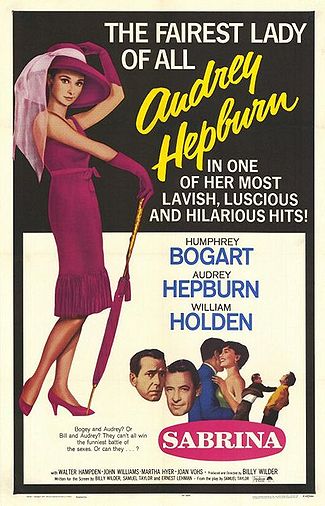
Sabrina (1954)


Starring Audrey Hepburn, Humphrey Bogart, and William Holden, with director Billy Wilder, the film begins with Sabrina (Hepburn) as a young girl. She lives with her father who is a chauffeur for a rich family. Sabrina loves the younger playboy son (Holden) however he gives her no serious attention. Depressed, Sabrina wants to kill herself and her father decides to send her off to culinary school in France. Some time passes and the grown up Sabrina is a perfect lady. Soon she catches the eye of Holden back home and all her dreams come true when they spend time together at a party. However, his older practical brother (Bogart) does not like it one bit since Holden has a fiancee. Wanting to get Sabrina away from his brother, Linus wines and dines her so the strategic wedding will stay on schedule. He then gives her a one way ticket and sends her off. Only afterward does he realize his own feelings for Sabrina and thus he decides to follow her. This film overall is a charming romance that is worth seeing.

4/5 Stars

Friday, December 20, 2013

The Caine Mutiny (1954)

With a stellar cast starring Humphrey Bogart, Van Johnson, Fred MacMurray, and Jose Ferrer among others, the film begins with a young ensign assigned to the mine sweeper named the Caine. After the first lax captain is reassigned, their new commander Queeg (Bogart) is a stickler for detail and order. After a series of incidents the crew becomes increasingly annoyed with him. The situation worsesn when Queeg begins to obsess about a few missing servings of strawberries. All these events boil over during a typhoon when the second-in-command (Johnson) prodded on, feels Queeg is unfit for command and he takes over control of the Caine. In the ensuing court martial, he is put on trial for mutiny and his attorney (Ferrer) must try to show Queeg to be truly unstable. Although he wins the case, everyone soon comes to realize Queeg was just a war-wearied man who gave a lot of himself. Despite some stark revelations the young ensign finally marries his girl and gets a pleasant surprise when he is reassigned to another boat.

                                                        4/5 Stars

Wednesday, December 18, 2013

The African Queen (1951)

With the ultimate pairing of Humphrey Bogart and Katharine Hepburn, this film throws together two starkly different people in extraordinary circumstances. Hepburn is a prim and proper missionary in Africa whose brother dies after a confrontation with German soldiers. Bogart is the rough-edged pilot of an old steamboat christened The African Queen. Together they take on the dangerous task of going down the river in order to sink a German ship. At first they are both at odds with each other and struggle to cope with their situation. However, with no one else to turn to, over time, they become close. Their bond is so great that they are willing to die rather than to be separated. This is truly a heartwarming story of love and loyalty with two legends who literally light up the screen.

                                     5/5 Stars

Tuesday, December 17, 2013

In a Lonely Place (1950) - Film-Noir

Starring Humphrey Bogart and Gloria Grahame with direction by Nicholas Ray, the film is about a struggling screenwriter with a hot temper. Dixon Steele (Bogart) has not written a good script in a while but then one evening he has an enthusiastic young woman explain a novel he is supposed to adapt since he has not read it. Everything goes seemingly normal however the next morning she is dead and Steele is the main suspect. The police investigate, including Steele's detective friend, but a neighbor gives an alibi which seems to save Steele. Soon Grahame begins to fall in love with him and vice versa. However, she soon realizes his violent side and second guesses Steele's innocence since he has such a violent history. Although they are to be married it is broken off when he finds out she was going to leave. Only then does Grahame find out he was indeed innocent but the damage is already done and their relationship cannot be saved. This is a pretty good film noir with powerful characters.

                                                       4.5/5 Stars

Monday, December 16, 2013

The Treasure of The Sierra Madre (1948)

Putting Humphrey Bogart in his element once again, The Treasure of The Sierra Madre is another wonderful adventure film. Directed by John Huston, it tells the story of three men who join together in their search for an elusive treasure in Mexico. At the beginning, they are in good spirits eager to become wealthy. However, when they finally strike it rich they find it is not all it is cracked up to be . The situation escalates and they become paranoid of each other. Finally, Bogart's character Dobbs is pushed over the edge and commits a malicious act out of desperation. Seemingly as an act of karma, he meets with another form of justice. However, it seems that by the end no one actually wins. A surprisingly good film, Sierra Madre takes your usual treasure hunt and realistically depicts man's greed which often can overpower everything else. Bogart was supported nicely by Walter Huston (the father of the director) and Tim Holt.

5/5 Stars

Monday, December 2, 2013

The Maltese Falcon (1941) - Film-Noir

This archetypal film-noir directed by John Huston, stars Humphrey Bogart as the detective Sam Spade. After an initial conversation with a mysterious woman, that same night two men end up dead. As Spade tries to understand what is going on, it puts him in contact with a paranoid little man and another man who is trailing him. All of them have something to do with a black bird and the situation gets more complicated when Spade meets the fat man. Rather surprisingly Spade ends up with the falcon but of course there has to be a twist. Soon enough the truth comes out of Brigid O'Shaughnessy and Spade coldly does his work. This film has great characters played by Mary Astor, Peter Lorre, Sidney Greenstreet, Ward Bond, and Elisha Cook Jr. The directing is good as well as the cinematography. This is the film that finally made Bogart a star and he would never look back.

5/5 Stars

Star of the Month: Humphrey Bogart

The man with the memorable speech impediment acquired from a WWI injury, Bogart began in the movies as a bit player in gangster films such as The Petrified Forest (1936) and Angels with Dirty Faces (1938). He finally made is major breakthrough as Sam Spade in The Maltese Falcon (1941) directed by John Huston, and from that point on he never looked back. He followed it up with his trademark performance as Rick Blaine in Casablanca (1942), then two Huston classics The Treasure of Sierra Madre (1948) and The African Queen (1951). The 1940s also saw the inception of his romantic pairing and eventual marriage to Lauren Bacall. They acted together in To Have and Have Not (1944), The Big Sleep (1946), Dark Passage (1947), and Key Largo (1948). Bogart continued to star in films in the 1950s including Sabrina and The Caine Mutiny before his death in 1957. He is undoubtedly one of the cultural legends of Hollywood with so many great film credits to his name. He could be a tough guy and a softie but he did it all with that iconic face and voice. Here's looking at you Bogey.

Saturday, July 14, 2012

Casablanca (1942)


Considered one of the greatest films of all-time this well-loved classic deserves to be here. It is the hallmark of Humphrey Bogart and Ingrid Bergman's careers. It has one of the greatest scripts of all time and it has achieved legendary status over the years. Many consider it purely the best film ever made and in all honesty, I would never try to refute that.

The film opens quickly and we are immersed in a world that is at the height of the Nazi terror and many people are fleeing Europe by way of Casablanca. It is a treacherous place full of pickpockets, corrupt authorities, refugees, and some tourists as well. Two German couriers have been murdered and some invaluable letters of transit have been stolen and that’s when we are first introduced to Rick’s CafĂ© Americain and its cynical proprietor Rick Blaine. A shady fellow named Uguarte comes to him with the letters and asks Blaine to keep them for him. However, later that night Uguarte is taken into custody and things get even more complicated. 

Wanted resistance leader Victor Laszlo is now in Casablanca, however a Major Strasser has arrived from Germany to take him in. To top it off Laszlo’s wife Ilsa was Blaine’s old flame in Paris and it didn't end well. Laszlo desperately needs the letters of transit to escape and he inquires about them. Soon he is led to Blaine but as he often admits Rick sticks his neck out for nobody. Laszlo shows his defiance against his enemies by leading the people in a round of "La Marseillaise" and as a result Rick’s is shut down. 

All the memories of Paris begin flooding back and then Ilsa confronts Rick in order to get the letters. This is possibly the most critical point in the film because this tense altercation ultimately renews the relationship between Rick and Ilsa. Rick asks her to trust him and he begins to take things into his own hands. The results of his actions created one of the great romantic and cinematic moments in the history of film. The whole film leading up to this point hints at it, but Rick truly is a sentimentalist at heart. He can live with the notion that they will always have Paris and that leads him to commit a selfless act of love.

This film holds such a tremendous presence in movie history it is amazing. Upon seeing the movie it made complete sense what all the hype was about. What more could you want than Bogey, Bergman, Casablanca, and some of the greatest quotes ever said? Do not forget the the French Captain Louis played by Claude Rains or the immortal tune of As Time Goes By sung by Dooley Wilson. However you also gain appreciation for the other interesting characters of Casablanca, some comical, some sympathetic, and others mysterious. We have a rogue gallery of everybody under the sun from Peter Lorre, Sidney Greenstreet, German soldiers, various guests, and all the staff at Rick's place. 

This movie has conflict and the uncertainty of war practically in every scene because at the time World War II was in full force. There is a broken romance and a forlorn hero who shows his courage in the end and as an audience we realize the transformation of Rick into a truly great man. Ilsa on her part has the most radiant face I have ever seen! If you take into consideration when this movie was made, it truly is wonderful to watch. You do not need explosions and violence, only great characters and a story with both drama and humor. Up until the final moments of the movie you are captivated the entire time. Then fittingly you are left with the two men walking off into the night with the words, “Louis I think this is the beginning of a beautiful friendship.”

 In fact with this film my thoughts always go back to the script. Lines like "Here's looking at you kid," "We'll always have Paris," and "Round up the usual suspects" are so rampant that you cannot possibly remember them all and I doubt there will ever be another film that is so immersed in American culture. In fact many of my favorite lines in the film are those that get overshadowed by the more famous lines.That is the sign of an amazing film that never grows old. Even those who have not seen this classic film like to think they have because the influence of Casablanca reaches everywhere.

5/5 Stars


Related Posts Plugin for WordPress, Blogger...